Here’s a transcription (for text-to-speech, font changing, translation, whatever):
The discovery of cyanide in Tylenol capsules occurred in those same weeks of October 1982. The existence of the poisoned capsules, all found in the Chicago area, was first reported on October 1. The New York Times wrote a story on the Tylenol scare every day for the entire month of October and produced twenty-three more pieces in the two months after that. Four of the stories appeared on the front page The poisoning received comparable coverage in media across the country, inspiring an immense government effort. Within days of the discovery of what proved to be the only cyanide-laced capsules, the Food and Drug Administration issued orders removing the drug from store shelves across the country. Federal, state, and local authorities were immediately on hand to coordinate efforts in states thousands of miles from where the tampered boxes appeared. No action was too extreme and no expense too great, they insisted, to save lives.
Investigators poured into Chicago to crack the mystery. More than 100 state, federal, and local agents worked the Illinois end of the case alone, filling twenty-six volumes with 11,500 pages of probe reports. The Food and Drug Administration had more than 1,100 employees testing 1.5 million similar capsules for evidence of poisoning, and chasing down every faint possibility of a victim of the new terror, according to the breathless news reports of the time. Tylenol’s parent company, Johnson & Johnson, estimated spending $100 million in the effort. Within five weeks, the U.S. Department of Health and Human Services issued new regulations on tamper-resistant packaging to avert repetition of such a tragedy.
In the end, the millions of dollars for CDC Tylenol investigations yielded little beyond the probability that some lone crackpot had tampered with a few boxes of the pain reliever. NO more cases of poisoning occurred beyond the first handful reported in early October. Yet the crisis showed how the government could spring into action, issue warnings, change regulations, and spend money, lots of money, when they thought the lives of Americans were at stake.
Altogether, seven people died from the cyanide-laced capsules; one other man in Yuba City, California, got sick, but it turned out he was faking it so he could collect damages from Johnson & Johnson.
By comparison, 634 Americans had been stricken with AIDS by October 5, 1982. Of these, 260 were dead. There was no rush to spend money, mobilize public health officials, or issue regulations that might save lives.
The institution that is supposed to be the public’s watchdog, the news media, had gasped a collective yawn over the story of dead and dying homosexuals. In New York City, where half the nation’s AIDS cases resided, The New York Times had written only three stories about the epidemic in 1981 and three more stories in all of 1982. None made the front page. Indeed, one could have lived in New York, or in most of the United States for that matter, and not even have been aware from the daily newspapers that an epidemic was happening, even while government doctors themselves were predicting that the scourge would wipe out the lives of tens of thousands.
[The Raw Story headline: “A new website will ship your ashes to the GOP Rep. of your choice is Trumpcare kills you”]
This reminds me of that picture I saw of someone at an AIDS protest in the 80s that had a jacket that said, “When I die leave me on the capitol steps” or something like that
Also yes fuck those bastards make them have to face the human sacrifice they’re signing to line their fucking pockets.
This search for niche groups led Subaru to the 3rd rail of marketing: They discovered that lesbians loved their cars. Lesbians liked their dependability and size, and even the name “Subaru.” They were four times more likely than the average consumer to buy a Subaru. […] Subaru decided to launch an ad campaign focused on lesbian customers. It was such an unusual decision—and such a success—that it pushed gay and lesbian advertising from the fringes to the mainstream.
If you’ve ever wondered why people joke about lesbians driving Subarus, the reason is not just that lesbians like Subarus. It’s that Subaru cultivated its image as a car for lesbians—and did so at a time when few companies would embrace or even acknowledge their gay customers.
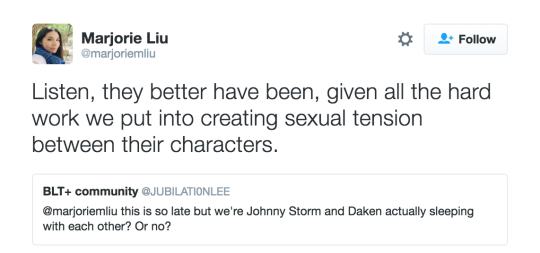
Marjorie Liu, who wrote Johnny briefly during his appearance in Daken: Dark Wolverine #4,confirmed on twitter very recently that Johnny and Daken had a sexual relationship.
Johnny’s bi/pan/polysexuality is canon now, although, probably because of the Fantastic Four’s current lack of popularity, not one sound was made about it in the media or in the Marvel fandom.
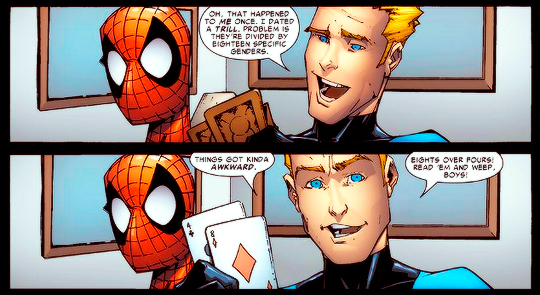
It’s not as if there’s nothing in canon itself to back up Liu’s statement. In 2005′s Spectacular Spider-Man #21, Johnny openly admits to having slept with at least one nonbinary alien:
In Fantastic Four #563, we even find out that there’s an alternate universe version of Johnny – in which he’s the older of the Storm siblings – where he is the one who is married to Reed Richards, not Sue:
In The New Mutants: Superheroes and the Radical Imagination of American Comics, comics scholar Ramzi Fawaz traces Johnny’s history as a queer figure all the way back to his initial appearance Fantastic Four #1, so Johnny is not only currently queer,he has always implicitly been written that way.
Sometimes the hints were subtle, like in his Fantastic Four #309 trip to Fire Island, which was, at the time it was published, a notorious gay vacation spot.
And sometimes the hints were more overt:
Maybe it’s just me, but I think that the fact that Johnny Storm, part of Marvel’s First Family and one of the founding members of the Fantastic Four, the team that is responsible for making the Marvel universe what it is today and which was once Marvel’s most popular and influential property, is officially bi/pan/poly IS A BIG DEAL.
JOHNNY STORM, FOUNDING MEMBER OF THE FANTASTIC FOUR AND MARVEL’S FIRST FAMILY, IS OFFICIALLY BI/PAN/POLY. IT’S IMPORTANT.








 myblog