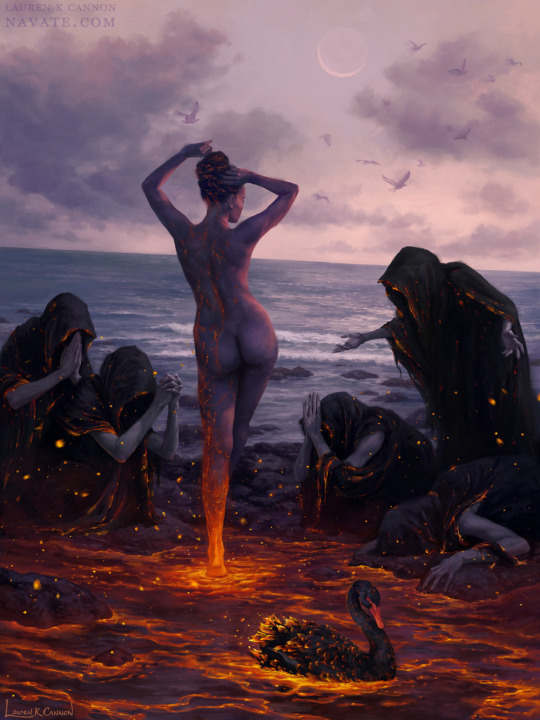
Do any of you know about that one painting with Aphrodite being born out of lava with a black swan by her side or did i completely hallucinate that? Been searching for a while but i can’t find it for shit.
I tried googling that description but no luck either, anyone might know what painting this might be (or if it does exist? cause it sounds sick lol)
It took a bit of googling magic, but I think I’ve found it.
This is what I’m here for. Not only do we need men supporting women who come out about sexual abuse but we really need men supporting other men when they come forward about these stories. Like not only am I happy that Brendan came forward but I’m so proud of Terry for voicing his support of Brendan. This is huge.
Brendan Fraser was sexually assaulted!? What the fuck!
Back in 2003 he got sexually assaulted by the former president of the
Hollywood Foreign Press Association. This was during the year “Looney Tunes: Back in Action” came out just to ruin that movie for everyone but nobody would listen to him.
It actually almost derailed his career, the effects were so devastating for him. Terry is the first celebrity I’ve seen even acknowledge or support him since he started telling his story, and really some of the only support I’ve seen in general. The fact that people still don’t know about Fraser’s story even now (he came out with it during the height of the me too movement last fall) shows that it was largely ignored/swept under because of his position as a victim, at least in the eyes of society and larger news publications.
I saw the tweets about this today, and I was like oh yeah, I remember hearing about that.
And then I saw the pictures and just— wow. What it would have meant to have these women in the movie, all this time. I can’t properly articulate it but it’s hitting me unexpectedly hard.
Wow thats a shame, even a nice old lady too. These Space Valkyries should have been left in.
I lived, ate, and breathed Star Wars from age 2 until 2005 when RotS finally beat the enthusiasm out of me, and I have NEVER, EVER in all my reading on behind-the-scenes and makings-of heard of these shots. It’s a shame there was no relaunched edit of the original trilogy they could have slipped these in OH FUCKING WAIT THERE’S BEEN LIKE 3 OF THOSE NOW.
Fuck. FUCK. Whoever decided to edit out and bury these needs to french kiss an angle grinder.
I want to see the old lady in the A-Wing. Seriously, it’s like, she’s somebody’s grandma. Some kid in the Outer Rim Territories got greased by the Empire for seeing something she wasn’t supposed to see, and her grandma, the bush pilot, decided “Fuck this, I’m gonna strap on an fighter and make the Empire fucking PAY for the moment it decided to fuck with MY FAMILY.”
DON’T. MESS. WITH. GRANDMA.
These are quickly being put into the “always reblog” category.
Whenever there is a war, there are women who are warriors. Then they get erased from history. Happens in real wars and fictional ones alike.
Less than 5% of general aviation licenses go to women. If these had been left in, you can bet that number would be higher.
^^^That knocked the breath out of me.
I just can’t believe they not only took them out, but refused to put them back in during the seventeen times they updated the movies. And of course the only possible explanation for this is: you do not belong here.
Literally though. How many stupid remasters have they done but THIS gets left out? Ugh
for the record the names of these characters are Sila Kott played by
Poppy Hands and Dorovio Bold played by Vivienne Chandler. I couldn’t find the name of the old woman though 😦
http://starwars.wikia.com/wiki/Dorovio_Bold
“As well as her appearance in the briefing, footage of the character in a cockpit during the Battle of Endor was also filmed, but not used in the final cut of the movie.”
http://starwars.wikia.com/wiki/Sila_Kott “Although played by British actress Poppy Hands in Return of the Jedi, Sila Kott was later dubbed over by an American man’s voice.”
So we’re teaching girls to be anxious wrecks and boys to disregard the possibility of consequences for incautious behavior.
This explains a lot of things. Like… why women are anxious wrecks and men are frequently surprised when it turns out their actions do in fact have consequences.
And why men don’t bother asking for help even when they really need it, and thus more frequently die from treatable health conditions (including depression), while women end up getting a broad stereotype of being hypochondriacs (and then having a hard time getting treatment for legitimate health concerns).
Anyway, if you read marriage certificates from church records, a full 85% of first marriages for young women were around 18-19 years old. The rest skewed higher, into the early twenties, with only a few being below that age and only one in a thousand was younger than 16.
The age of puberty has declined over the centuries as girls get better nutrition, as well, so throughout the middle ages the age at which a girl could expect her first period was around 16, where modern girls often get it much younger.
The idea that women in earlier ages were married and mothers in their early teens is a myth. Marriages of children were usually only between noble families, and made for political reasons, or creepy old bastards who wanted a child-wife and could get away with it because they were rich and powerful. They often would point to the fact that the Roman elite did the same thing as justification. The Romans, of course, would point to the Greeks doing the same thing as justification, the Greeks pointed at the Assyrians, and so on back through the ages.
It was considered disgusting by normal people then and still is.
This myth is still brought out and touted by sick fuckers. Know it for what it is; a falsehood.
And EVEN among the nobility marriages at such a young age were a much rarer occasion than those apologists would make you believe.
Let’s look an an egregious example, Henry the bloody VIII:
First marriage:
He was 18, Katharine of Aragon was 23.
Second marriage:
He was 40/41, Anne Boleyn, depending on which theory you believe, was anywhere between 24 to 32.
Third marriage:
He was 44, Jane Seymour was 28.
Fourth marriage:
He was 48, Anne of Cleves was 25
Fifth marriage:
He was 48, Catherine Howard, depending on which source you believe, was between 17-22. And yes, people at the time actually were squicked out by this age difference. And rightly so.
Sixth marriage:
He was 51, Catherine Parr was 31.
Even the most notorious LECHER and WIFE MURDERER in history did not marry teenagers in at least 5 if not 6 out of 6 marriages.
And here’s another Tudor tidbit, both Henry VII and VIII knew how traumatic and damaging it is for women marrying/having children too young. Henry VII’s mother was married at 12 and gave birth to Henry VII at 13. It caused so much damage and trauma that she never had another child after him despite being married three times.
So yes CUT THAT SHIT OUT. Teenage girls are NOT adults and anyone preying on them is pure evil.
YOU
I LIKE YOU
And as for the marriage of Elizabeth Woodville to King Edward IV, she was 27 at the time. He? Was 22.
She had been married before, and did marry young…at the age of sixteen or seventeen, to Sir John Gray, who was about five years her senior.
@systlin This is good information, but do you have a source for the information about how most marriages back in the day were not actually usually from a younger age? I tried Googling it but I can only find things talking about modern day issues.
Well, if you don’t want to spend months crawling through digitized copies of marriage records preserved in church archives from the 12th through 18th centuries from England, Italy, Germany, France, ect (which you can do, and it will show you I’m right) you can go read
“
Medieval Households” by David Herlihy, Harvard University Press, 1985. He did the archive crawling for you.
Also
Peter Laslett’s book “The World We Have Lost”, where he details over a thousand marriage certificates, and he dug through many more in the writing of the work.
Wait. I am spanish. Do they actually think henry/enrique VII married fucking katherin/catalina de Aragón as a teenager?
You know we see films about this in school and every one is pretty much adult there, both fisically and in the story.
There’s this…really weird trend in a lot of pseudo-European fantasy/ ‘historical’ books to have girls marry like…really young, to vastly older dudes. Like at about 13, getting married off to like 30 year olds. And then say “Well that’s what it was like back then.”
(Sideyes G.R.R.M)
And…no. No it wasn’t. That’s gross. England was creeped TF out when Henry VIII married Catherine Howard when she was between 17 and 22 and he was 48 as stated above, and rightly so.
All of this is excellent, and there is one thing I would add:
When you DID have these super-young marriages between nobility, it was more or less the same thing we do today when we scream “DIBS!” over who gets the TV remote. You might have a 13-year-old lord marrying a 14-year-old girl, but they weren’t expected to actually act as husband and wife, not yet. He had schooling to finish, she had to learn how to run a household. The union was purely political and not to be consummated until later–you know, at a point when they were 18 or 19 and she could carry a child without dying of it and he could actually support a wife.
I think one of the major causes of many misconceptions like this is because people have been basing their preceptions on life in the past off of works of FICTION written in the past. When I was studying Early Modern literature in undergrad, this topic was brought up regarding the presence of sexual abuse. There were many plays and what not that implied things such as this, however the scene in the play WAS CONSIDERED SHOCKING to people back then too. It would be like someone 500 years from now watching some grimdark noire mopey antihero cop drama in a city of sin, and then thinking that it demonstrates what the everyday life of today’s world is. No one in this thread is saying things like that NEVER happened back then, it was just… not as common as historical fiction and fiction written 500 years ago might have you believe. As OP mentioned, historical documents from the time have far fewer child marriages and sexual abuse than literary works from the time do.
Rebloging for A+ history.
We were just talking about child marriages today, so reblogging for history.
Female figurine from the Hohle Fels cave near Stuttgart, about 35,000 years old. Interpreted as a pornographic pin-up.
“The Earliest Pornography” says Science Now, describing the 35,000 year old ivory figurine that’s been dug up in a cave near Stuttgart. The tiny statuette is of a female with exaggerated breasts and vulva. According to Paul Mellars, one of the archaeologist twits who commented on the find for Nature, this makes the figurine “pornographic.” Nature is even titling its article, “Prehistoric Pin Up.” It’s the Venus of Willendorf double standard all over again. Ancient figures of naked pregnant women are interpreted by smirking male archaeologists as pornography, while equally sexualized images of men are assumed to depict gods or shamans. Or even hunters or warriors. Funny, huh?
Consider: phallic images from the Paleolithic are at least 28,000 years old. Neolithic cultures all over the world seemed to have a thing for sculptures with enormous erect phalluses. Ancient civilizations were awash in images of male genitalia, from the Indian lingam to the Egyptian benben to the Greek herm. The Romans even painted phalluses on their doors and wore phallic charms around their necks.
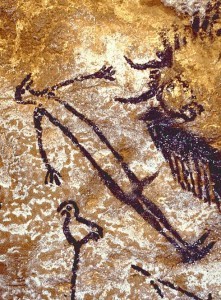
Ithyphallic figure from Lascaux, about 17,000 years old. Interpreted as a shaman.
But nobody ever interprets this ancient phallic imagery as pornography. Instead, it’s understood to indicate reverence for male sexual potency. No one, for example, has ever suggested that the Lascaux cave dude was a pin-up; he’s assumed to be a shaman. The ithyphallic figurines from the Neolithic — and there are many — are interpreted as gods. And everyone knows that the phalluses of ancient India and Egypt and Greece and Rome represented awesome divine powers of fertility and protection. Yet an ancient figurine of a nude woman — a life-giving woman, with her vulva ready to bring forth a new human being, and her milk-filled breasts ready to nourish that being — is interpreted as pornography. Just something for a man to whack off to. It’s not as if there’s no other context in which to interpret the figure. After all, the European Paleolithic is chock full of pregnant-looking female statuettes that are quite similar to this one. By the time we get to the Neolithic, the naked pregnant female is enthroned with lions at her feet, and it’s clear that people are worshipping some kind of female god.
Yet in the Science Now article, the archaeologist who found the figurine is talking about pornographic pin-ups: “I showed it to a male colleague, and his response was, ‘Nothing’s changed in 40,000 years.’” That sentence needs to be bronzed and hung up on a plaque somewhere, because you couldn’t ask for a better demonstration of the classic fallacy of reading the present into the past. The archaeologist assumes the artist who created the figurine was male; why? He assumes the motive was lust; why? Because that’s all he knows. To his mind, the image of a naked woman with big breasts and exposed vulva can only mean one thing: porn! Porn made by men, for men! And so he assumes, without questioning his assumptions, that the image must have meant the same thing 35,000 years ago. No other mental categories for “naked woman” are available to him. His mind is a closed box. This has been the central flaw of anthropology for as long there’s been anthropology. And even before: the English invaders of North America thought the Iroquois chiefs had concubines who accompanied them everywhere, because they had no other mental categories to account for well-dressed, important-looking women sitting in a council house. It’s the same fallacy that bedevils archaeologists who dig up male skeletons with fancy beads and conclude that the society was male dominant (because powerful people wear jewelry!), and at another site dig up female skeletons with fancy beads and conclude that this society, too, was male dominant (because women have to dress up as sex objects and trophy wives!). Male dominance is all they can imagine. And so no matter what they dig up, they interpret it to fit their mental model. It’s the fallacy that also drives evolutionary psychology, the central premise of which is that human beings in the African Pleistocene had exactly the same values, beliefs, prejudices, power struggles, goals, and needs as the middle-class white professors and students in a graduate psychology lab in modern-day Santa Barbara, California. And that these same factors are universal and unchanged and true for all time.
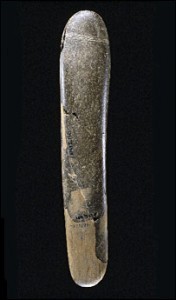
Hohle Fels phallus, about 28,000 years old. Interpreted as a symbolic object and …flint knapper. Yes.
That’s not science; it’s circular, self-serving propaganda. This little figurine from Hohle Fels, for example, is going to be used as “proof” that pornography is ancient and natural. I guarantee it. Having been interpreted by pornsick male archaeologists as pornography because that’s all they know, the statuette will now be trotted out by every every psycho and male supremacist on the planet as “proof” that pornography is eternal, that male dominance is how it’s supposed to be, and that feminists are crazy so shut the fuck up. Look for it in Steven Pinker’s next book. ***
P.S. My own completely speculative guess on the figurine is that it might be connected to childbirth rituals. Notice the engraved marks and slashes; that’s a motif that continues for thousands of years on these little female figurines. No one knows what they mean, but they meant something. They’re not just random cut marks. Someone put a great deal of work into this sculpture. Given that childbirth was incredibly risky for Paleolithic women, they must have prayed their hearts out for help and protection in that time. I can imagine an elder female shaman or artist carving this potent little figure, and propping it up somewhere as a focus for those prayers.
On the other hand, it is possible that it has nothing to do with childbearing or sexual behavior at all. The breasts and vulva may simply indicate who the figure is: the female god. Think of how Christ is always depicted with a beard, which is a male sexual characteristic, even though Christ isn’t about male sexuality. The beard is just a marker. Or, given the figurine’s exaggerated breasts, it may have something to do with sustenance: milk, food, nourishment.
The notion that some dude carved this thing to whack off to — when he was surrounded by women who probably weren’t wearing much in the way of clothes anyway — is laughable.
#reclusiveleftist #women’s history #porn #white men are stupid
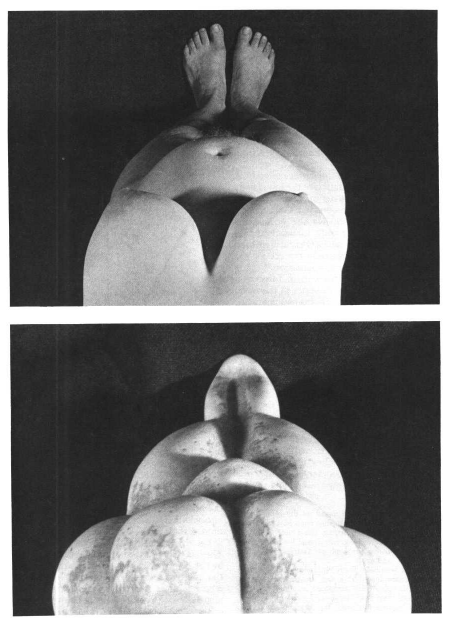
There was a post doing the rounds on tumblr a while back that I wish I could find, but most of it seemed to be taken from this study by LeRoy McDermott, Comparing Modern Bodies with Prehistoric Artifacts.
When looked at from above, as a woman observes herself, the breasts of PKG-style figurines assume the natural proportions of the average modern woman of childbearing age. For example, the dimensions of the breasts of the off-illustrated Venus of Willendorf are comparable to those of a 26-year-old mother-to-be with a 34C bust (see fig. 5). When foreshortened from above, even the apparent hypertrophic dimensions of the Venus of Lespugue and the best-preserved figurine from Dolní Vestonice enter into a reasonably normal, albeit buxom, range.
McDermott goes on to theorise that the reason most of these hyper-female statues are missing a head and hands is that the head, obviously, can’t be viewed by the sculptor without access to a reflection of some kind. As the hands are in a constant state of motion making the figurine, it would also be difficult to have a fixed reference to work from.
The whole thing reminds me of that oft-quoted Sandi Toksvig article:
When I was a student at Cambridge I remember an anthropology professor holding up a picture of a bone with 28 incisions carved in it. “This is often considered to be man’s first attempt at a calendar” she explained. She paused as we dutifully wrote this down. “My question to you is this – what man needs to mark 28 days? I would suggest to you that this is woman’s first attempt at a calendar.”
It was a moment that changed my life. In that second I stopped to question almost everything I had been taught about the past. How often had I overlooked women’s contributions? How often had I sped past them as I learned of male achievement and men’s place in the history books?
Working (loosely) in an archeological field for this past year has made me realise how much is taken for granted about ancient culture and to what degree we patch up the remnants of the past with modern values and notions of gender and sexuality. On a daily basis I’m asked – when in character – who my husband is, whether I’m a cook, why I’m holding a spear and carry a dagger and slingshot as part of my kit. These notions of a woman’s place are so ingrained that the children on school trips to the hill fort frequently can’t believe it when I tell them our Chieftain is a woman. Even if the only Iron Age Briton they can name is Boudica, they have a hard time getting their head around it.
I know I’ve reblogged this before, but I just can’t help myself. It’s way too cool.
things men dont seem to understand: women have always existed and contributed to society as more than just sex objects





























 myblog