why does no one ever talk about how lewis and clark met why isn’t that taught in history classes it’s like some rom-com meet-funny trope and i’ve literally never heard it brought up. literally the start of one of the most famous friendships in america and no one talks about it.
Wasn’t Clark just Lewis’ commanding officer? I guess I don’t know this story either. Can you tell it?
yes!! oh my god!!
so at twenty-one years of age, stupid stubborn hotheaded ensign meriwether lewis decides to get hella drunk and crash the party of one of his superior officers, starting an argument over politics (namely, defending thomas jefferson, his neighbor and veritable father figure) and insulting his host and basically being an embarrassment. so, he’s arrested and leveled with a court martial!! because this ridiculous boy can’t mind his fucking manners when he’s tipsy apparently!!
but instead of having to explain to his poor mother why he got booted out of the continental army, he’s acquitted (”with honor” bc apparently i’m not the only one who plays favorites when it comes to meriwether lewis), but he has to be reassigned so he doesn’t piss off his commanding officer again (awk). and whose brand new sharp-shooting rifle unit does he get transferred to?? take a wild guess!!!! that’s right, william clark’s!!!! and over the next six months meri falls deepfuck in totally platonic bro-love with him until clark resigns his commission for family reasons. then, roughly eight years later, lewis writes him to ask if maybe he’d like to travel to the ends of the earth by his side and, well, the rest is history.
But how do you know it was platonic
i hope you guys understand that when i say “platonic” i say it in the patronizing sarcastic tone of voice i always use when i talk about meriwether lewis’s big ol’ crush on his bff. maybe i can’t prove totally that he was v gay and probably at least a little bit madly in love with clark, but damn i wanna believe love exists ok.
lewis’s obvious sexual repulsion of women, his inability to find a wife, his desire to live with clark after the expedition, that last letter he wrote to clark before his violent death that we don’t have because clark burned it – we can read a lot into all of this if we want to, but even besides all of that the point remains that meriwether lewis was intensely fond of clark, and that they cared deeply for one another, and that their personalities complemented and completed one another in a way that makes you think twice about soulmates.
actually, sacagawea was a sixteen-year-old kidnapped shoshone girl sold into sexual slavery to a french trader named toussaint charbonneau, who pissed power couple lewis and clark off to no end due to generally just being who he was as a person.
whereas lewis had no real interest in women from what we can tell from his writings, he actually wrote about how much he admired sacagawea’s extreme fortitude and numerous skills that helped them throughout their journey. lewis also actually delivered sacagawea’s child!! she had a very difficult birth (probably because she was a child), which sent lewis into multiple kinds of panic. clark, however, really doted on sacagawea and her son; he gave them both nicknames, looked out for their safety during the trip, and was very close to them even after the expedition and ended up adopting sacagawea’s son. he was also a notoriously bad speller and i don’t think he ever spelt charbonneau’s name correctly ever not even once (which makes me think of the blenderdick cucumberpatch meme tbh).
Chanel was never tried for her crimes as a collaborator. She used her connections, information, and money to pay off the right people and cover her tracks.
She was briefly arrested and questioned by a French judge, but basically got off scott-free and allegedly told her family that she was freed by Winston Churchill.
Just so everyone is aware, Chanel S.A. is currently owned by the Wertheimers, a Jewish family that regained control of the brand after Coco tried to use her Nazi ties against them while the fled. Basically, at this point, it’s Chanel in name only.
Not to diss on European mythologies but can we seriously have some fuckin’ recognition that there are religions and mythologies that are not Greek or Norse. Why the fuck did I learn about the Greeks 6 times but we never fucking talked about Africa or even really the mythologies and beliefs of native peoples?
The Titanoboa, is a 48ft long snake dating from around 60-58million years ago. It had a rib cage 2ft wide, allowing it to eat whole crocodiles, and surrounding the ribcage were muscles so powerful that it could crush a rhino. Titanoboa was so big it couldn’t even spend long amounts of time on land, because the force of gravity acting on it would cause it to suffocate under its own weight.
I’m so glad they aren’t around
omg me too. I’m scared enough of 26 ft long anacondas. I’m so happy Megalodons, those giant sharks, aren’t alive either
Praise natural selection
I remember watching Walking with Beasts or something similar, or some British tv show about evolution
The subject was something like a 12 foot long water scorpion
I was so startled by its sudden appearance and narration that I yelped: “12 fucking feet?!?! I’m fucking glad it’s extinct!”
Dude, prehistory was home to some fucking TERRIFYING creatures. For some reason, everything back then was enormous and scary. Extinction doesn’t always have to be a bad thing!
And Poppy, what you saw was an arthropod known as Pterygotus (it was actually featured in Walking With Monsters). Not only was it as big (or maybe even bigger) than your average human, it had a stinger the size of a lightbulb. REALLY glad that bugger isn’t around anymore.
Also, Megalodon deserves to be mention again, because just hearing its name makes me want to never be submerged in water ever again.
GOD, I HATE THIS POST. HOW DO WE EVEN KNOW THAT SHIT ISN’T STILL AROUND? LURKING? EVOLVING? WE DON’T. WE DON’T KNOW SHIT ABOUT SHIT DOWN THERE. THE OCEAN IS A PRIMEVAL HELLSCAPE NIGHTMARE AND WE ALL JUST DIP OUR STUPID FRAGILE UNPROTECTED FETUS BODIES AROUND THE EDGES OF IT LIKE THAT’S NORMAL. FUCK THE OCEAN.
this is so relevant to my interests
It wasn’t just the predators. North Carolina was once home to giant ground sloths…
THAT IS A GODDAMNED LEAF-EATING SLOTH.
We’ve got a skeleton of one of these fuckers at the museum downtown, and man, just being NEAR it is unsettling.
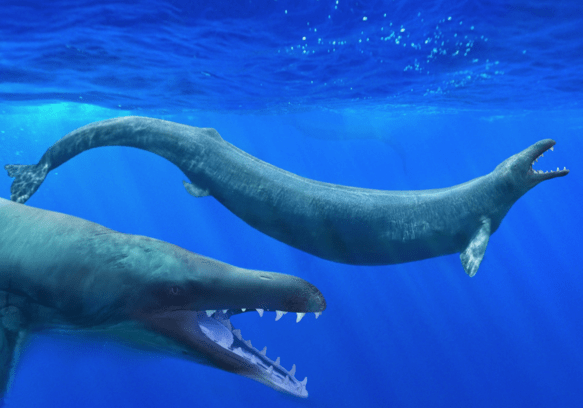
DON’T FORGET PREHISTORIC WHALES, SOME OF THOSE FUCKERS WERE TERRIFYING
AMBULOCETUS WAS AMPHIBIOUS AND PRETTY BADASS
BASILOSAURUS WAS THIS GIANT REPTILIAN CETACEAN THAT PROBABLY SWAM LIKE A DUMB EEL BECAUSE OF ITS TINY FLUKES BUT THIS FUCKER WAS 60 FEET LONG AND AT THE TOP OF THE MARINE FOOD CHAIN
AND THEN THERE’S MY FAVORITE, ZYGOPHYSETER, WHICH WAS THIS HUGE EARLY SPERM WHALE THAT ATE SHARKS AND OTHER WHALES
IT WAS NOTHING BUT TEETH
The reason why the animals in the prehistoric times were so big was because there was much more oxygen in the atmosphere if I recall correctly. Because there was so much oxygen and so few carbon gasses, life on earth was able to grow to terrifying lengths and heights, don’t forget how giant the bugs were.
I have never seen so much prime nope in a single post
Also important to note that megalodon is theorized to still be alive,possibly living in the darkest depths of the ocean. They haven’t found signs of its extinction
He was a Jew who fled nazi germany, who coudn’t get a damn job anywhere near his field bc of being Jewish, but people are shocked he was against racism. of course he was. he lived being a victim of it.
it’s always so funny learning about the Great Depression in grade school cuz they don’t ever talk about how latinx and Hispanic people were lowkey deported to Mexico even if they weren’t Mexican and how the depression was literally twice as worse for black people who were the first fired and last hired. like educators always report these tragedies by how they impacted whites UNLESS you are in a class like AA studies or something.
This is the truth. The experiences of poc have been outright erased from history in US public education. The white experience is labeled as universal in order to cover up white crimes and to keep white kids ignorant so that we uphold white supremacy throughout our lives.
I remember in my medieval philosophy class my professor once mentioned that silent reading wasn’t always the norm and that rather people would read outlouad typically. One of the most well known examples of this is in Augustine’s Confessions where he remarks that he was astonished at how Ambrose of Milan would read books silently and without moving his lips or mouth at all. It wasn’t that people didnt have the ability to read silently like people would be aware if a situation called for them to read the contents quietly such as a politician or general recieving a letter with sensitive information. The point rather is that in those cases the person would intentionally will themselves to read quietly and if you were going to sit down and read a book or scroll the default was that you would read it out loud so someone that read silently as their norm would be seen as ‘odd’. And by ‘odd’ I dont mean that people thought they were a freak or stupid just that it was a strange quirk.
As a matter of fact reading silently might’ve been seen as a sign that someone was an incredibly heavy reader such as with Ambrose. The reason being that one of the reasons vocalized reading was the norm had to do with how people wrote texts like it was pretty common for there to be irregularities with the script or especially that it was highly common for writings tonothavespacesinbetweenwordssoreadingoutloudfeltlikeamorenaturalasawaytomakeouttheindividualwords. An incredibly ‘veteran’ reader like Ambrose (Augustine also mentions Ambrose could read quickly) might develop mental shortcuts letting them more easily pick part the individual words that had been squished together and in doing so simply gradually drop the habit of reading out loud because it wasnt an aid to them any longer. In Latin Europe this changed when Irish monks in the late 7th century developed the practice of writing with more uniform letters as well as separating different words by leaving blank spaces between them. This slowly spread to the rest of Latin Europe (at least with the monastaries) until it finally became the norm in the 12th century, just in time for the explosive importation of scientific and philosophical literature from the Arabic world which was nice.
Anyway back to before that happened, something my professor said that was pretty interesting was that that if you stepped into a medieval library before this change ocurred is that youd be struct by how much talking was seeming to go on the monks read to themselves. That combined with the fact that the expensive nature of books often meant might could be attached to chains meant that a medieval library would be have a continuous din of murmuring and rattling metal which is interesting imagery for a library.
i edited this post bc i wrote it on my phone at first and some of the wording was awkward + added a little more info
also if youre interested in this then look up the historian paul saenger he’s written a bunch about this especially the relevance of word spacing
hear me out: all-female remake of lord of the rings
hear me out: all-female racially diverse remake of lord of the rings
Isn’t 2 humans, an Elf, 4 Hobbits, a Dwarf and a celestial being in a corporeal form already racially diverse?
Well, at least in how most high fantasy uses the word “race.”
No.
If every fantasy race is imagined as entirely white it absolutely does not count as racial diversity. The implications of a world where every race (or every race that matters) is white are quite the opposite, in fact, and point to conscious or unconscious white supremacy.
feel free to re-imagine the characters as any race you want, but please understand that, in context, tolkien’s characters (almost) all being canonically white does not “point to conscious or unconscious white supremacy”
you see, tolkien’s mythology was intentionally written as stories for the english people. they had no mythology of their own – all of “their” stories had originated from other cultures. middle earth originated as an alternate history of europe (especially england) as it may have been told from an ancient english mythological perspective.
as the professor himself wrote:
“I was from early days grieved by the poverty of my own beloved country: it had no stories of its own … Do not laugh! But once upon a time (my crest has long since fallen) I had a mind to make a body of more or less connected legend, ranging from the large and cosmogonic, to the level of romantic fairy-story… which I could dedicate simply to: to England; to my country.”
“I am historically minded. Middle-earth is not an imaginary world… The theatre of my tale is this earth, the one in which we now live, but the historical period is imaginary.”
people from europe, are, of course, mostly white, so it naturally follows that the people living in an alternate history of europe would be white – as well as the fantasy creatures borne out of european mythology. including a lot of non-europeans in it would make no more sense than native american mythologies featuring white people, or japanese mythologies featuring black people, and so on.
basically, middle earth = europe, southern areas = africa, and eastern areas = asia. there are poc in tolkien’s arda but most (not all) come from places outside middle earth, which makes sense when you put it in a real world context.
diversity in fantasy is great, but please do not assume that everything that does not meet your criteria of diversity is automatically racist. thank you
When I die, they’re going to be doing the autopsy and find out that the cause of death is a bleeding stomach ulcer that, upon close inspection, actually is text that reads out the commentary directly above my own here.
“which makes sense when you put it in a real world context”
The degree to which pre-modern Britain included people of African origin within its population continues to be a topic of considerableinterest and some controversy. Previous posts on this site have discussed a variety of textual, linguistic, archaeological and isotopic
evidence for people from the Mediterranean and/or Africa in the British
Isles from the Late Bronze Age through to the eleventh century AD.
However, the focus in these posts has been on individual sites, events
or periods, rather than the question of the potential proportion of
people from Africa present in pre-modern Britain per se and how
this may have varied over time. The aim of the following post is thus to
briefly ponder whether an overview of the increasingly substantial
British corpus of oxygen isotope evidence drawn from pre-modern
archaeological human teeth has anything interesting to tell us with
regard to this question.
The following post offers a map and brief discussion of the Islamic gold
coins of the later eleventh and twelfth centuries that have been found
in England and their context. Whilst clearly rare finds, there are now
ten coins of this period known, all but one of which are thought to most
probably have their origins in Spain. Moreover, these coins are
considered to be the survivals of a potentially substantial body of this
material present in England at that time.
The aim of the following post is to offer a draft look at an interesting
Arabic account of early medieval Britain that appears to have its
origins in the late ninth century. Despite being rarely mentioned by
British historians concerned with this era, this account has a number of
points of interest, most especially the fact that it may contain the
earliest reference yet encountered to there having been seven kingdoms
(the ‘Heptarchy’) in pre-Viking England and the fact that its text
implies that Britain was still considered to be somehow under Byzantine
lordship at that time.
The following short note is based on a narrative preserved in the eleventh-century Fragmentary Annals of Ireland that
tells of a Viking raid on Morocco in the 860s. This raid is said to
have led to the taking of ‘a great host’ of North African captives by
the Vikings, who then carried them back to Ireland, where they
reportedly remained a distinct group—’the black men’—for some
considerable period of time after their arrival.
Edwards, Paul, and James Walvin. “Africans in Britain, 1500-1800.“ The African Diaspora: Interpretive Essays. Edited by Martin L. Kilson and Robert I. Rotberg. Cambridge, MA: Harvard University Press, 1976: 173-204.




 myblog