This is Simone Segouin, an incredible resistance fighter. Her first mission was to steal a Nazi’s bike, and thereafter went on with her team to derail a train, blow up bridges, arrest 25 Nazis in a single day, and, well, liberate France. She’s still alive at the age of 90.
The fertility of enslaved women was examined by owners to make sure they were able to birth as many children as possible. Secretly, slave owners would impregnate enslaved women and when the child was born and grew to an age where he could work on the fields, they would take the “very same children (of their) own blood and make slaves out of them,” as pointed out in the National Humanities Center Resource Toolbox on Slaveholders’ Sexual Abuse of Slaves.
It was common for the slave to be subordinated sexually to the master–even men with enslaved males. It was part of the enslaved man’s function as an “animated tool,” an instrument of pleasure.
When enslaved males turned 15 years old–and younger in some cases–they had their first inspection. Boys who were under-developed, had their testicles castrated and sent to the market or used on the farm. Each enslaved male was expected to get 12 females pregnant a year. The men were used for breeding for five years. One enslaved man name Burt produced more than 200 offspring, according to the Slave Narratives.
To combat the high rate of death among the enslaved, plantation owners demanded females start having children at 13. By 20, the enslaved women would be expected to have four or five children. As an inducement, plantation owners promised freedom for enslaved female once she bore 15 children, according to Slavery in the United States by John Simkin.
If the enslaved woman was considered “pretty,” she would be bought by plantation owner and given special treatment in the house, but often subjected to horrifying cruelty by the master’s wife, including the beheading of a child because he was the product of a enslaved-master affair.
Often, the plantation owner would entertain his friends by forcing the enslaved Blacks to have orgies–multiple pairings having sex in front of them. And the white men often would participate in the debauchery.
People often forget to examine and discuss the sexual exploitative nature of slavery and how it was “necessary” to ensure the survival of the slave system. It’s sooooo sick! My soul is disturbed. We are a resilient people but damnit if our history isn’t one of terror and unimaginable evil. God bless and comfort my ancestors! Smh. #Hate it!
If the enslaved woman was considered “pretty,” she would be bought by
plantation owner and given special treatment in the house, but often
subjected to horrifying cruelty by the master’s wife, including the
beheading of a child because he was the product of a enslaved-master
affair.
Just wanted to highlight this part too for people trying to excuse white women’s part in the abuse of slaves back then and their children.
Reading this took everything out of me, broke me down.
This is the reason why your slavery narratives in your fiction and your fetishization of Black bodies are abhorrent. This is why I will always shit directly on anyone who tries to sell the slavery as a ‘romantic meet-cute’ in any form of media.
Here is a list of people you might have never heard of, but their accomplishments and bravery have changed the history.
And this is not the full list of all outstanding black people, who made so much and never got credit for it. Just imagine how much we have lost, how many stories we have not heard, what a big part of history we’re missing? Without all these people the world could be totally different. Let’s take a moment to appreciate them.
Believe there is an HBO movie out about Vivien Thomas, don’t remember the name of the movie but it was really good. Believe Alan Rickman and Yasiin Bey play the doctors.
Especially the first map…Ethiopia alone is unconquered.
Ethiopia was actually briefly occupied by Fascist Italy in the 1930s, but it largely resisted the earlier primary waves of European colonization.
The emperor Haile Selassie of Ethiopia, made a powerful and prophetic speech to the League of Nations (which condemned the Italian aggression but ultimately did nothing to stop it) in 1936 where he made the famous anti-fascist and anti-imperialist cautionary statement, “today us, tomorrow you.” And he was right, because not even a year later Nazi Germany started making territorial demands of its neighbors which eventually escalated to the massive bloodshed of World War 2, where Hitler tried to conquer almost all of Europe.
if anyone ever tries to tell you that the ancient greeks were more sophisticated than us, just remember that there was a ship war between plato and aeschylus over whether achilles or patroclus was the top in their relationship, while xenophon was off complaining that he didn’t ship that
“Is Achilles A Twink” – the greatest thread in the history of forums, locked by a moderator after 12,239 pages of heated debate,
On Holocaust Remembrance Day, this twitter account is posting the names and photos (when available) of refugees turned away from America who became victims of Naziism. #NoBanNoWall #RefugeesWelcome
(Please leave this caption in place.)
The St. Louis was a ship carrying 908 Jewish refugees in 1939. The US Government forced them to turn around and go back to Germany–knowing full well that they would be sent to concentration camps.
I took a class about Ancient Egypt last semester and we had a whole lecture dedicated to talking about how gay Niankhkhnum and Khnumhotep were. Their tomb walls were decorated with scenes of them ignoring their wives in favor of embracing each other. In one scene, the couple is seated at a banquet table that is usually reserved for a husband and wife. There’s an entire motif of Khnumhotep holding lotus flowers which in ancient Egyptian tradition symbolizes femininity. Khnumhotep offers the lotus flower to Niankhkhnum, something that only wives were ever depicted as doing for their husbands. In fact, Khnumhotep is repeatedly depicted as uniquely feminine, being shown smaller and shorter than his partner Niankhkhnum and being placed in the role of a woman. Size is a big deal in Egyptian art, husbands are almost always shown as being larger and taller than their wives. So for two men of equal status to be shown in once again, a marital fashion, is pretty telling. Not to mention they were literally buried together which is the strongest bond two people could share in ancient Egypt, as it would mean sharing the journey to the afterlife together. And yet 90% of the academic text about these two talks about these clues in vague terms and analyze the great “brotherhood” they shared, and the enigma of Khnumhotep being depicted as feminine. Apparently it’s too hard for archaeologists to accept homosexuality in the ancient world, as well as the possibility of trans individuals.
On the last note, I was walking around the Field Museum of Natural History in Chicago and there is a mummy on exhibit. It caught my attention because the panel that was describing it was talking about how it was a woman’s body in a male coffin and wow, the Egyptian working that day really screwed that up. My summary, not actual words, sorry I can’t remember verbatim but it basically said that someone screwed up.
They claimed that the Egyptians screwed up a burial.
The Egyptians. Screwed up. A burial.
Now I’m not an expert in Ancient Egypt but from what I know, and what the exhibit was telling me, burials and the afterlife and all that jazz DEFINED the Egyptian religion and culture. They don’t just ‘screw up’. So instead of thinking outside the box for two seconds and wonder why else a genetically female body was in a male coffin, the ‘researchers’ blatantly disregard the rest of their research and decided to call it a screw up. Instead of, you know, admitting that maybe this mummy presented as male during his life and was therefore honorably buried as he was identified. But it would be too much of a stretch to admit that a transgender person could have existed back then.
(Sorry I can’t find any sources online and it’s been like 2 years but it stuck in my mind)
There’s a lot of bigoted historian dragging on my dash these days and it makes me happy.
Once again, more proof that we queers have ALWAYS been here, and it’s a CHOSEN narrative to erase them.
my night manager (who is a gay man) and i sometimes sit down and exchange stories and tidbits about our sexuality and our experiences in the queer cultural enclave. and tonight he and i were talking about the AIDS epidemic. he’s about 50 years old. talking to him about it really hit me hard. like, at one point i commented, “yeah, i’ve heard that every gay person who lived through the epidemic knew at least 2 or 3 people who died,” and he was like “2 or 3? if you went to any bar in manhattan from 1980 to 1990, you knew at least two or three dozen. and if you worked at gay men’s health crisis, you knew hundreds.” and he just listed off so many of his friends who died from it, people who he knew personally and for years. and he even said he has no idea how he made it out alive.
it was really interesting because he said before the aids epidemic, being gay was almost cool. like, it was really becoming accepted. but aids forced everyone back in the closet. it destroyed friendships, relationships, so many cultural centers closed down over it. it basically obliterated all of the progress that queer people had made in the past 50 years.
and like, it’s weird to me, and what i brought to the conversation (i really couldn’t say much though, i was speechless mostly) was like, it’s so weird to me that there’s no continuity in our history? like, aids literally destroyed an entire generation of queer people and our culture. and when you think about it, we are really the first generation of queer people after the aids epidemic. but like, when does anyone our age (16-28 i guess?) ever really talk about aids in terms of the history of queer people? like it’s almost totally forgotten. but it was so huge. imagine that. like, dozens of your friends just dropping dead around you, and you had no idea why, no idea how, and no idea if you would be the next person to die. and it wasn’t a quick death. you would waste away for months and become emaciated and then, eventually, die. and i know it’s kinda sophomoric to suggest this, but like, imagine that happening today with blogs and the internet? like people would just disappear off your tumblr, facebook, instagram, etc. and eventually you’d find out from someone “oh yeah, they and four of their friends died from aids.”
so idk. it was really moving to hear it from someone who experienced it firsthand. and that’s the outrageous thing – every queer person you meet over the age of, what, 40? has a story to tell about aids. every time you see a queer person over the age of 40, you know they had friends who died of aids. so idk, i feel like we as the first generation of queer people coming out of the epidemic really have a responsibility to do justice to the history of aids, and we haven’t been doing a very good job of it.
Younger than 40.
I’m 36. I came out in 1995, 20 years ago. My girlfriend and I started volunteering at the local AIDS support agency, basically just to meet gay adults and meet people who maybe had it together a little better than our classmates. The antiretrovirals were out by then, but all they were doing yet was slowing things down. AIDS was still a death sentence.
The agency had a bunch of different services, and we did a lot of things helping out there, from bagging up canned goods from a food drive to sorting condoms by expiration date to peer safer sex education. But we both sewed, so… we both ended up helping people with Quilt panels for their beloved dead.
Do the young queers coming up know about the Quilt? If you want history, my darlings, there it is. They started it in 1985. When someone died, his loved ones would get together and make a quilt panel, 3’x6’, the size of a grave. They were works of art, many of them. Even the simplest, just pieces of fabric with messages of loved scrawled in permanent ink, were so beautiful and so sad.
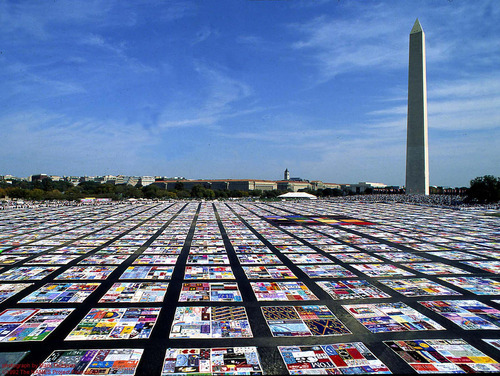
They sewed them together in groups of 8 to form a panel. By the 90s, huge chunks of it were traveling the country all the time. They’d get an exhibition hall or a gym or park or whatever in your area, and lay out the blocks, all over the ground with paths between them, so you could walk around and see them. And at all times, there was someone reading. Reading off the names of the dead. There was this huge long list, of people whose names were in the Quilt, and people would volunteer to just read them aloud in shifts.
HIV- people would come in to work on panels, too, of course, but most of the people we were helping were dying themselves. The first time someone I’d worked closely with died, it was my first semester away at college. I caught the Greyhound home for his funeral in the beautiful, tiny, old church in the old downtown, with the bells. I’d helped him with his partner’s panel. Before I went back to school, I left supplies to be used for his, since I couldn’t be there to sew a stitch. I lost track of a lot of the people I knew there, busy with college and then plunged into my first really serious depressive cycle. I have no idea who, of all the people I knew, lived for how long.
The Quilt, by the way, weighs more than 54 tons, and has over 96,000 names. At that, it represents maybe 20% of the people who died of AIDS in the US alone.
There were many trans women dying, too, btw. Don’t forget them. (Cis queer women did die of AIDS, too, but in far smaller numbers.) Life was and is incredibly hard for trans women, especially TWOC. Pushed out to live on the streets young, or unable to get legal work, they were (and are) often forced into sex work of the most dangerous kinds, a really good way to get HIV at the time. Those for whom life was not quite so bad often found homes in the gay community, if they were attracted to men, and identified as drag queens, often for years before transitioning. In that situation, they were at the same risk for the virus as cis gay men.
Cis queer women, while at a much lower risk on a sexual vector, were there, too. Helping. Most of the case workers at that agency and every agency I later encountered were queer women. Queer woman cooked and cleaned and cared for the dying, and for the survivors. We held hands with those waiting for their test results. Went out on the protests, helped friends who could barely move to lie down on the steps of the hospitals that would not take them in — those were the original Die-Ins, btw, people who were literally lying down to die rather than move, who meant to die right there out in public — marched, carted the Quilt panels from place to place. Whatever our friends and brothers needed. We did what we could.
OK, that’s it, that’s all I can write. I keep crying. Go read some history. Or watch it, there are several good documentaries out there. Don’t watch fictional movies, don’t read or watch anything done by straight people, fuck them anyway, they always made it about the tragedy and noble suffering. Fuck that. Learn about the terror and the anger and the radicalism and the raw, naked grief.
I was there, though, for a tiny piece of it. And even that tiny piece of it left its stamp on me. Deep.
2011
A visual aid: this is the Quilt from the Names Project laid out on the Washington Mall
I was born (in Australia) at the time that the first AIDS cases began to surface in the US. While I was a witness after it finally became mainstream news (mid-85), I was also a child for much of it. For me there was never really a world Before. I’m 35 now and I wanted to know and understand what happened. I have some recommendations for sources from what I’ve been reading lately:
And the Band Played On: Politics, People and the AIDS Epidemicby Randy Shiltsis a seminal work on the history of HIV/AIDS. It’s chronological and gives an essential understanding of all the factors that contributed to the specific history of the virus’ spread through the US and the rest of the world, the political landscape into which it landed (almost the worst possible)*. Investigative journalism and eyewitness account. Shilts was himself an AIDS casualty in 1994.
Larry Kramer is a pretty polarising figure and he had issues with the sexual politics of gay New York to begin with (see: Faggots) but he’s polarising for a reason: he’s the epidemic’s Cassandra. Reports from the Holocaustcollects his writings on AIDS.
I don’t think I can actually bring myself to read memoirs for the same reason I can’t read about the Holocaust or Stalinist Russia any more. But I have a list:
Read or watchThe Normal Heart. Read or watch Angels in America. Read The Mayor of Castro Streetor watchMilk. Dallas Buyers Clubhas its issues but it’s also heartbreaking because the characters are exactly the politically unsavory people used to justify the lack of spending on research and treatment. It’s also an important look at the exercise of agency by those afflicted and abandoned by their government/s, how they found their own ways to survive. There’s a film of And the Band Played Onbut JFC it’s a mess. You need to have read the book.
Everyone should read about the history of the AIDS epidemic. Especially if you are American, especially if you are a gay American man. HIV/AIDS is not now the death sentence it once was but before antiretrovirals it was just that. It was long-incubating and a-symptomatic until, suddenly, it was not.
Read histories. Read them because reality is complex and histories attempt to elucidate that complexity. Read them because past is prologue and the past is always, in some form, present. We can’t understand here and now if we don’t know about then.
*there are just SO MANY people I want to punch in the throat.
Please, if you are following me right now, read this. It’s so important to remember this, to understand how much we lost. To understand that, when I was a little kid, the biggest thing about the community was that shared loss.
There is a lot I want to say and I don’t have the spoons but. Yeah. This is all so, so important. Please read this.
I’m in my mid 30s, and grew up in a major gay center of the US (not SF or NY). I remember there was this quiet bubbling for a very long time. A neighbor who lost a “house mate”, people talking about being careful, and so on. And then… suddenly it was out in the open. And we were all terrified.
Also in my mid thirties and well, this shit was on TV on the 80′s when I was a kid in the UK:
Both of these were on the TV repeatedly, over and over again. The reason “small groups” is mentioned is tied to the horrific deliberate policy of not mentioning homosexuality in the UK (which included the infamous Section 28 where you couldn’t talk about it schools, lest you be accused of ‘promoting’ homosexuality.)
Basically? If we weren’t going to get nuked in a Cold War apocalypse, we all thought we were going to die in the 80′s. This is why people of my vintage of LGBTIA+ are so twitchy about AIDS now being regarded as ‘just another disease’, because not only did people we knew die from it, but we had this nightmare fuel piped into our brains for years!
Yup, this. I’m 43 now, so AIDS and Section 28 were a fucking double-tap execution of my teenage dreams. In ‘86 when the monolith ad came, I was just under fifteen. I was coming on seventeen when Thatcher (may her name rot in fucking infamy) brought in Section 28. Clause 28 it was called before it was passed. Catch 28 was what I called it, after Catch-22 by Joseph Heller. Why? Because the year it was being touted, I was in the newly-fledged debate society my English teacher had set up. Me and this girl decided this hot topic, so relevant to ourselves as school kids, was perfect debate material. We suggested it to the teacher, but he had to veto it: if he let us debate it, that could have been deemed a breach of the law itself. Let that sink in for a second. The law literally forbade us from even questioning the law.
Man, with that fucking law and AIDS lowering over us, that nuclear winter wasn’t just a spectre; it was a dead future already with us; it was a fucking metaphoric existential condition of soul death. I was too young at the time to personally know anyone who died from HIV, but the reason I found the courage to come out to my folks in my early twenties was because one of my teacher father’s colleagues–Eileen her name was–volunteered in hospice care, and when she came round to visit she’d talk about her gay friends, all sick and dying. It was only the fact that my folks were somehow, gobsmackingly, actually friends with this woman that made me, one night after she’d left, heart in my mouth, turn to my parents and say, “I’ve got something to tell you…”
Fuck, AIDS was the fucking Grim Reaper at large in the world, far as i was concerned. Sex would’ve been a game of Russian Roulette, so even if the age of consent for a would-be Sodomite hadn’t been fricking twenty one right up until I was past it and legal anyways, I can’t imagine my teen self daring to step out into that dance of death.
Which is the other side of it, really. I mean, you had those who came of age just in time to get out and find their community before they had that community scoured from them, friend by friend. But for me, in the era before Facebook and Tumblr and Twitter and whatnot, that devastation was all elsewhere, in the cities that should have been havens for us. San Francisco, London, New York, all these wonderlands we might have whispered of in our hearts, the bright lights we would have set out for, to find love and pride and rainbow flags and glorious fuckery. Mother Sodom. To my generation, that was a distant city razed to a desolation of salt and sarcoma. Born just too late, when we heard of these havens, of this haven culture of gay communities distributed through the cities of the world, we heard of it first in images of its annihilation. The tombstone and the iceberg that stood where the glory of Mother Sodom had been scoured from the earth.
That’s why this blog’s called Fuck Yeah New Sodom, by the way. Because I believe with every fibre of my being that we can and must rebuild what was lost. I look at that image of the quilts laid out in a grid and I see city blocks, streets running crosswise, boulevards stretching away to the horizon, and buildings rising where each patchwork quilt lies on the ground, all those losses become bold and brilliant multicoloured blueprints for a future of ferociously defiant diversity. Aye, fuck the tragedy and the noble suffering. Fucking fuck it to fuck and then some. Let the raw naked grief and the raw naked rage that goes with it serve as fuel for the fight to rebuild. I came of age into the fucking wasteland made by HIV, but since I was spared… I’m damned if I won’t see Mother Sodom risen anew before I die.
Bayard Rustin was an openly gay Black man who was Martin Luther King’s right hand man. He planned the Million Man March and was subject to scrutiny for his sexuality and deemed a “deviant” and “pervert”.
Bayard Rustin can be found in nearly every picture of MLK yet he has undoubtedly been erased from history. We have to fix that.
Well then, let’s bring that name back.
Bayard Rustin, openly gay, human rights activist, proud black man.
(the guy on the left in case you wondered)
Yeah he was literally the guy who was the head of planning the March on Washington.
If you want to learn more about him, there’s a great documentary on him called Brother Outsider: The Life of Bayard Rustin
So I learned my new favorite history fact in my AP US class today. It’s hilarious and goes a bit like this
In 1989, President Bush sent troops to Panama to capture the dictator and drug lord, Manuel Noriega. But Noriega had fled to (I had to look up the full name) the Apostolic Nunciature of the Holy See. The troops couldn’t exactly get in, so they surrounded the place and has to wait him out, or somehow force him out.
And it’s crazy how they did it.
The literal United States Navy SEALs did this
And it is real history
They blasted rock and roll music for days until he gave up
Apparently, Noriega only liked opera, so this annoyed him.
But it gets better.
The playlist was not only obnoxiously loud and obnoxiously American, it had a sense of irony.
Here are some highlights:
Danger Zone
Freedom Fighter
Gonna Tear Your Playhouse Down
Give It Up
I Fought the Law and the Law Won
If I Had a Rocket Launcher
Nowhere to Run
Panama
Paranoid
Prisoner of Rock and Roll
Rock and a Hard Place
Stay Hungry
They’re Coming to Take Me Away
This Means War
Wanted Dead or Alive
And my personal favorite, and a thing that actually happened:
Never Gonna Give You Up
I just…
Imagine the board meeting
“Huh, how are we going to force this guy out of hiding?”
“Oh, I have an idea! Why don’t we blast loud rock music?”
“That just might work! And we should do it with a sense of irony, just to make it funnier!”



 myblog