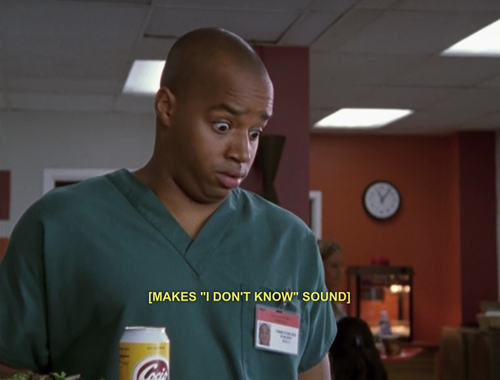
You know what I think is really cool about language (English in this case)? It’s the way you can express “I don’t know” without opening your mouth. All you have to do is hum a low note, a high note, then another lower note. The same goes for yes and no. Does anyone know what this is called?
These are called vocables, a form of non-lexical utterance – that is, wordlike sounds that aren’t strictly words, have flexible meaning depending on context, and reflect the speakers emotional reaction to the context rather than stating something specific. They also include uh-oh! (that’s not good!), uh-huh and mm-hmm (yes), uhn-uhn (no), huh? (what?), huh… (oh, I see…), hmmn… (I wonder… / maybe…), awww! (that’s cute!), aww… (darn it…), um? (excuse me; that doesn’t seem right?), ugh and guh (expressions of alarm, disgust, or sympathy toward somebody else’s displeasure or distress), etc.
Every natural human language has at least a few vocables in it, and filler words like “um” and “erm” are also part of this overall class of utterances. Technically “vocable” itself refers to a wider category of utterances, but these types of sounds are the ones most frequently being referred to, when the word is used.
Reblog if u just hummed all of these out loud as you read them
what she means: the words “christmas tree” are used in the hobbit, and since we know that bilbo is the author of the hobbit, hobbits must have christmas which means there must be a middle earth jesus. but hobbits seem to be the only ones who have the concept of christmas which means it was probably a hobbit jesus. but frodo says in return of the king that no hobbit has ever intentionally harmed another hobbit so who crucified hobbit jesus?? were there other hobbit incarnations of religious figures?? was there hobbit moses?? did jrr tolkien even think about this at all??
Wait wait I might actually have an answer
Tolkien wrote The Hobbit like waaaay before he even dreamed up the idea for Lord of the Rings, so when he DID dream up LotR, he had a whole bunch of stuff that didn’t make sense. Like plotholes galore
Like for example in the first version Gollum was a pretty nice dude who lost the riddle contest graciously and gave Bilbo the ring as a legit present and was very helpful and it was super nice and polite and absolutely nobody tried to eat anyone because this is a story for kids and that’s very rude
But that doesn’t work with LotR, so Tolkien went back and re-released an updated version of The Hobbit with all the lore changes and stuff to fix everything that didn’t work
This is the version we know and love today
BUT rather than pretend the early version never existed, Tolkien went and worked the retcon into the lore
If you pay attention in Fellowship, there’s a bit where Gandalf is telling Frodo about the ring and he mentions how Bilbo wasn’t entirely honest about the manner in which it was found
To us modern readers, this doesn’t make a ton of sense, so mostly we just breeze by it–but actually that line is referencing the first version of The Hobbit
The pre-retcon version of the Hobbit is canonically Bilbo’s original book. The original version with Nice Gollum is canonically a lie Bilbo told to legitimize his claim to the ring and absolve him of the guilt he feels for his rather shady behavior
Then the post-retcon version is an in-universe edited edition someone went and released later to straighten out Bilbo’s lies
So it’s 100% plausible that the in-universe editor who fixed up Bilbo’s Red Book and translated it from whatever language Hobbits speak was a human who knew about Christmas Trees and tossed the detail in to make human readers feel more at home, because that’s the kind of thing that sometimes happens when you have a translator editor person dressing up a story for an audience that doesn’t know the exact cultural context in which the original story was written
Tolkien was a medieval scholar and medieval stories are rife with that sort of thing, so like… yeah
Not only all that, but Tolkien was also working within a frame narrative that he wasn’t the real author, but a translator of older manuscripts; so, in-universe, the published The Hobbit isn’t actually Bilbo’s book, but rather Tolkien’s copy of an older copy of an older copy of an older copy of Bilbo’s book. So when errors and anachronisms came up, he would leave them there instead of fixing them, and he may have even put some in intentionally; what we’re supposed to get from the “Christmas tree” bit is that the first scribe to translate the book from Westroni to English couldn’t come up with an accurate analogue for whatever hobbits do at midwinter.
Yes. Another example of tolkien doing this is him using, for instance, Old High Gothic to represent Rohirric – not because the people of Rohan actually spoke that language, but because Old High Gothic had the same relationship with English that Rohirric had with Westron (Which is the Common Language spoken in the West of Middle-Earth). There’s tons of that stuff in the book.
Like, Merry and Pippin’s real names (In Westron) are Kalimac Brandagamba and Razanur Tûk, respectively (to pick just one example of this). Tolkien changed their names in English to names which would give us English-speakers the same kind of feeling as those names would to a Westron-speaker. Lord of the Rings is so much deeper than most readers realise.
tolkein’s entire oevre is just one epic in-joke with the oxford linguistics department imo
and it’s a zeugma where one of the words is literal and one is metaphorical which is the BEST KIND
I didn’t know about zeugmas until just now! That is so awesome, everybody:
zeug·ma
ˈzo͞oɡmə/
noun
a figure of speech in which a word applies to two others in different senses (e.g.,John and his license expired last week ) or to two others of which it semantically suits only one (e.g., with weeping eyes and hearts ).
things english speakers know, but don’t know we know.
WOAH WHAT?
That is profound. I noticed this by accident when asked about adjectives by a Japanese student. She translated something from Japanese like “Brown big cat” and I corrected her. When she asked me why, I bluescreened.
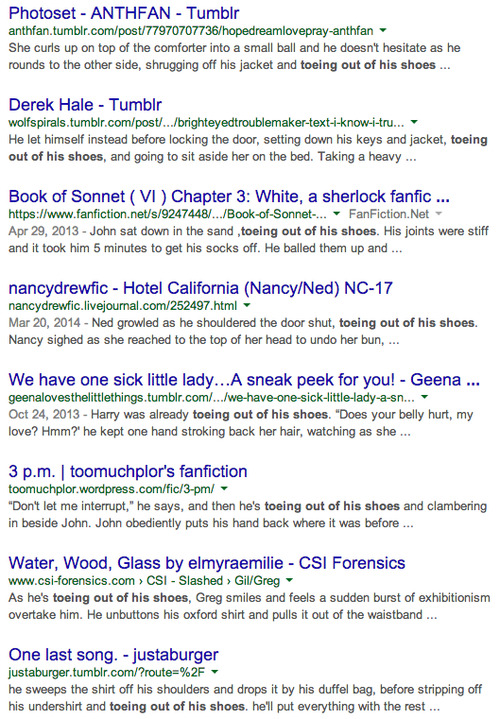
so i just googled the phrase “toeing out of his shoes” to make sure it was an actual thing
and the results were:
it’s all fanfiction
which reminds me that i’ve only ever seen the phrase “carding fingers through his hair” and people describing things like “he’s tall, all lean muscle and long fingers,” like that formula of “they’re ____, all ___ and ____” or whatever in fic
idk i just find it interesting that there are certain phrases that just sort of evolve in fandom and become prevalent in fic bc everyone reads each other’s works and then writes their own and certain phrases stick
i wish i knew more about linguistics so i could actually talk about it in an intelligent manner, but yeah i thought that was kinda cool
Ha! Love it!
One of my fave authors from ages ago used the phrase “a little helplessly” (like “he reached his arms out, a little helplessly”) in EVERY fic she wrote. She never pointed it out—there just came a point where I noticed it like an Easter egg. So I literally *just* wrote it into my in-progress fic this weekend as an homage only I would notice. ❤
To me it’s still the quintessential “two dudes doing each other” phrase.
I think different fic communities develop different phrases too! You can (usually) date a mid 00s lj fic (or someone who came of age in that style) by the way questions are posed and answered in the narration, e.g. “And Patrick? Is not okay with this.” and by the way sex scenes are peppered with “and, yeah.” I remember one Frerard fic that did this so much that it became grating, but overall I loved the lj style because it sounded so much like how real people talk.
Another classic phrase: wondering how far down the _ goes. I’ve seen it mostly with freckles, but also with scars, tattoos, and on one memorable occasion, body glitter at a club. Often paired with the realization during sexy times that “yeah, the __ went all they way down.” I’ve seen this SO much in fic and never anywhere else
whoa, i remember reading lj fics with all of those phrases! i also remember a similar thing in teen wolf fics in particular – they often say “and derek was covered in dirt, which. fantastic.” like using “which” as a sentence-ender or at least like sprinkling it throughout the story in ways published books just don’t.
LINGUISTICS!!!! COMMUNITIES CREATING PHRASES AND SLANG AND SHAPING LANGUAGE IN NEW WAYS!!!!!!!
I love this. Though I don’t think of myself as fantastic writer, by any means, I know the way I write was shaped more by fanfiction and than actual novels.
I think so much of it has to do with how fanfiction is written in a way that feels real. conversations carry in a way that doesn’t feel forced and is like actual interactions. Thoughts stop in the middle of sentences.
The coherency isn’t lost, it just marries itself to the reader in a different way. A way that shapes that reader/writer and I find that so beautiful.
FASCINATING
and it poses an intellectual question of whether the value we assign to fanfic conversational prose would translate at all to someone who reads predominantly contemporary literature. as writers who grew up on the internet find their way into publishing houses, what does this mean for the future of contemporary literature? how much bleed over will there be?
we’ve already seen this phenomenon begin with hot garbage like 50 shades, and the mainstream public took to its shitty overuse of conversational prose like it was a refreshing drink of water. what will this mean for more wide-reaching fiction?
I’m sure someone could start researching this even now, with writers like Rainbow Rowell and Naomi Novik who have roots in fandom. (If anyone does this project please tell me!) It would be interesting to compare, say, a corpus of a writer’s fanfic with their published fiction (and maybe with a body of their nonfiction, such as their tweets or emails), using the types of author-identification techniques that were used to determine that J.K. Rowling was Robert Galbraith.
In an earlier discussion, Is French fanfic more like written or spoken French?, people mentioned that French fanfic is a bit more literary than one might expect (it generally uses the written-only tense called the passé simple, rather than the spoken-only tense called the passé composé). So it’s not clear to what extent the same would hold for English fic as well – is it just a couple phrases, like “toeing out of his shoes”? Are the google results influenced by the fact that most published books aren’t available in full text online? Or is there broader stuff going on? Sounds like a good thesis project for someone!
Toeing out of one’s shoes may be a fanfic trend, but toeing them off is in the Oxford English Dictionary:
[Image description: A screencap of the Oxford Dictionary’s web page for the word “toe.” The first definition for the verb “to toe” is [with object and usually with adverbial] push, touch, or kick with one’s toe: ‘he toed off his shoes and flexed his feet.’ ]
How it mutated from common usage “toed off” to fanfic usage “toed out” is a mystery that has been lost to time, but I felt like pointing out that it’s not something fanficcers invented out of whole cloth.
@deadcatwithaflamethrower This seems like the sort of discourse you’d be happy to jump in on…thoughts?
Well…the internet has sped up the evolution of language and word definitions and useage at a pace where linguists are basically screaming “WAIT WAIT WE CAN’T KEEP UP WITH THIS SHIT WHAT THE HELL GUYYYYYSSSSSSS–”
Take yes and yeah.
Yea. Yeh. Yas. Yis. Those last two? Those are very, very new, and yet they are EVERYWHERE. Before global communication, new terminology didn’t spread that fast.
It’s fucking awesome.
Oh my god I can’t believe this post came back around! Because this:
people describing things like “he’s tall, all lean muscle and long fingers,” like that formula of “they’re ____, all ___ and ____” or whatever in fic
I found it in a non-fic setting!! Specifically, Dan Simmons’ 1989 (Hugo award winning!) novel Hyperion, which I’ve lately read and noticed it in, because of this post and wondering if it was ever used in non-fic settings. And it has been. At least by Dan Simmons.
You know what I think is really cool about language (English in this case)? It’s the way you can express “I don’t know” without opening your mouth. All you have to do is hum a low note, a high note, then another lower note. The same goes for yes and no. Does anyone know what this is called?
These are called vocables, a form of non-lexical utterance – that is, wordlike sounds that aren’t strictly words, have flexible meaning depending on context, and reflect the speakers emotional reaction to the context rather than stating something specific. They also include uh-oh! (that’s not good!), uh-huh and mm-hmm (yes), uhn-uhn (no), huh? (what?), huh… (oh, I see…), hmmn… (I wonder… / maybe…), awww! (that’s cute!), aww… (darn it…), um? (excuse me; that doesn’t seem right?), ugh and guh (expressions of alarm, disgust, or sympathy toward somebody else’s displeasure or distress), etc.
Every natural human language has at least a few vocables in it, and filler words like “um” and “erm” are also part of this overall class of utterances. Technically “vocable” itself refers to a wider category of utterances, but these types of sounds are the ones most frequently being referred to, when the word is used.
Reblog if u just hummed all of these out loud as you read them
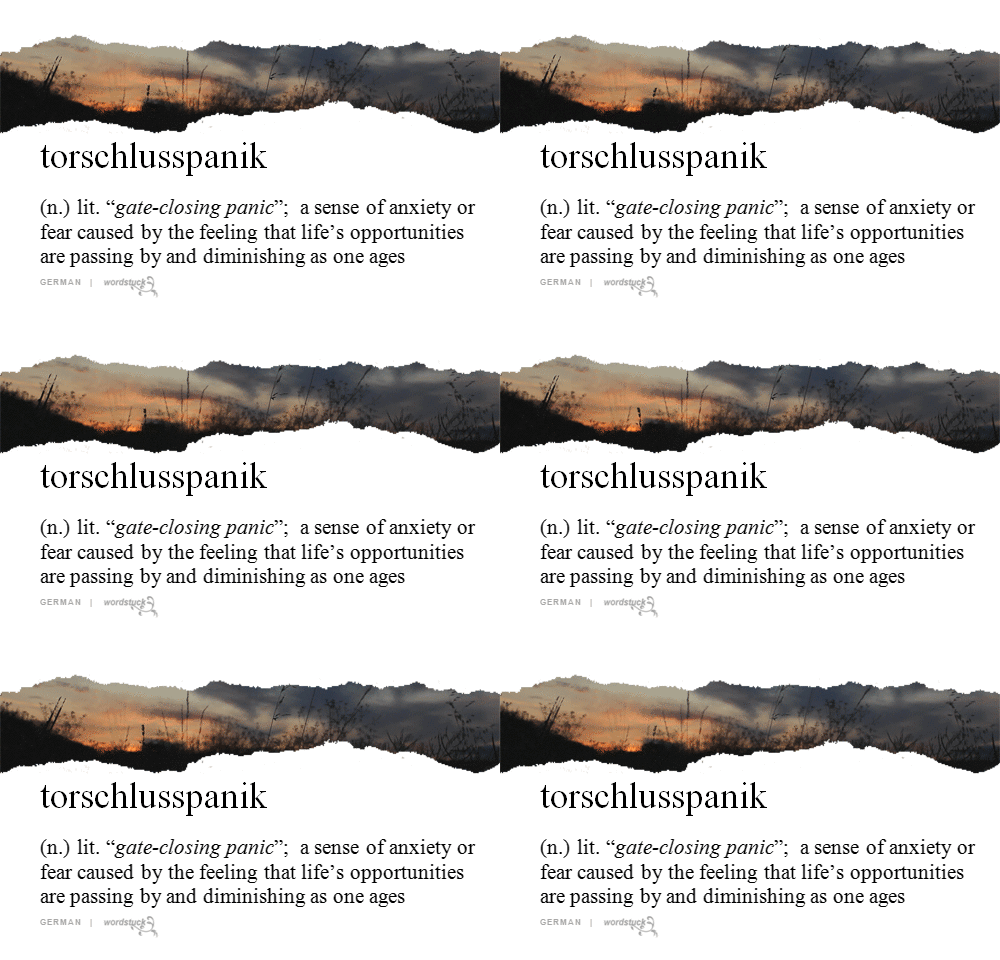
There’s probably a German compound word for that feeling you get at 2am when you’re single in your mid twenties and the creeping doubt that you’ve somehow missed your only chance at love because you didn’t meet someone in college and now it’s too late
The german word you are looking for is ‘Torschusspanik’
You’re saying that the responsibility for avoiding miscommunication lies entirely with the listener, not the speaker, which explains why you haven’t been able to convince anyone to help you down from that wall.

 myblog