So I get really narky when people pull the whole ‘oh Eowyn’s
storyline came to such a sucky ending; she was really cool going around killing
orcs and Witch-Kings and then she got shoved into a traditional girly role by marrying
Faramir and becoming a healer’ thing, because no. No-no-no-no-no. Not only does that
stray dangerously into the territory of ‘women only have worth if they’re doing
traditionally blokey things’, but that misses almost the entire point of Lord of the Rings.
Tolkien was in the trenches in the first world war, right?
He got all that ‘for death and glory’ shit shoved down his throat, that was the
whole point about the war, it was when so many people came to see how awful and
misleading all the propaganda about winning glory through violence and death was. And Tolkien’s work completely shows
that: it’s why the hobbits, who’ve never craved power or battle the way men do,
are the heroes of the book; it’s
why strong men like Aragorn and Faramir are shown to be lovers of peace rather
than war. It’s why the quote – but I do not love the bright sword for its sharpness, nor the arrow for
its swiftness, nor the warrior for his glory; I love only that which they
defend – is so poignant and beautiful, when
seen in the context of all Tolkien had gone through. He’d seen all but one of
his closest friends die in an utterly pointless war; the prevalent message in
his books is ‘if you’re going to have that many people die, let it be for
something worth dying for.’ (Like
defending your home from the lord of all darkness, for example.)
And Eowyn
might be a fantastic female character, but she’s also got so much development
to go through, and she’s by no means perfect. I find it really interesting that when Eowyn talks to Aragorn
about wanting to go off and fight she never really actually mentions protecting
her people, but speaks about wanting to ‘face peril and battle’, and to
do ‘great deeds’. And it’s not that Eowyn doesn’t want to protect her people, because of course she does, but she’s also got such a
driving motivation within her to do glorious and fell deeds simply for the sake
of valour and renown. It’s one of her defining features, having an attitude
that got so many young men killed in the war and which, obviously, Tolkien
would have been very wary of.
(Also, I think, there’s so much in Eowyn that wants to prove
herself to be more than ‘a mere woman’; because twice in that conversation she
asserts that she’s no mere ‘dry-nurse’ or ‘serving-woman’, but a member of the
house of Eorl and therefore capable of greater things. There’s almost this
slight sense of Eowyn considering herself more than ‘just’ a domesticated woman that I
sometimes get from her in the books? Which is very sad – the idea of Eowyn having less regard for others of her sex who do mind the house or raise the children – and why I so love that ‘I am no man’ moment in RotK. Eowyn’s no longer hiding herself, or dismissing fellow women as the weaker sex,
but acknowledging and embracing the fact that women in all their forms can fuck you up.)
And then we reach
the Houses of Healing, and Eowyn yearning for death in battle just like her
Uncle Theoden, and basically buying into that whole world war one ethos that
Tolkien would have considered so poisonous. Which is why her friendship and
courtship with Faramir is so fricking beautiful.
Remember that quote I wrote earlier? That’s from Faramir. He’s not backing down
from conflict, he’s in no way less of a ‘real man’ than anyone else; he’s just
saying there needs to be more to the fight than simply having a fight. There needs to be a reason; something worth
fighting for. Eowyn recognises that Faramir is a good man in every sense of the
word: he’s strong and valiant, but he doesn’t fight simply to prove himself or
for the sake of winning glory, he fights for other people. And Faramir gently challenges Eowyn on her
idolisation of battle-glory and encourages her not to scorn gentleness or
peace, and he’s so freaking good for her.
(Seriously. Can we just stop for a moment and think about how
wonderful Eowyn and Faramir are for each other: Faramir encouraging Eowyn to
turn towards life and healing and openness while never denying her strength or courage, and Eowyn giving Faramir the
validation and security he never got after so many years of an awful
relationship with his father? I honestly don’t know why I don’t get all giddy
about these two more often, because they make the very best otp.)
And the result of the departure of the Shadow and her
friendship with Faramir is Eowyn’s decision that ‘I will be a shieldmaiden no longer, nor vie with the great Riders, nor take joy only in the songs of slaying. I
will be a healer, and love all things that grow and are not barren.’
I think that last bit is so important because I’m certain
that Tolkien doesn’t mean for Eowyn to immediately pack up her sword and shield
and become a good girl sitting at home with her knitting and waiting for the
men to return home after the fight – after all, she’s going to be the wife of
the Steward of Gondor and there’s a lot of mess to clean up after the War of
the Ring. Eowyn’s probably still going to find herself defending hearth and
home from time to time. But the important thing is that she’s no longer
defining herself simply by the doing of valiant deeds; she’ll no longer compare
herself to the great warriors of her house and feel lacking simply because she
hasn’t killed as many men. Most importantly, she’s not going to take joy only in the songs of the slaying, in
destruction and death. Tolkien was all about healers symbolising life and
rebirth, and Eowyn’s decision to become one – to aid in the preservation of
life rather than the taking of it – is so beautiful. I don’t think Tolkien ever
wrote Eowyn’s ending to make her reclaim her ‘lost femininity’; I think it’s a
lovely way of adding to the ever-present theme in Lord of the Rings of hope and
frailty and healing and friendship over glory and battle and strife.
JUMBA:Now, this is interesting. PLEAKLEY:What? JUMBA:626 was designed to be a monster, but now he has nothing to destroy.
You see, I never gave him a greater purpose.
What must it be like to have nothing… not even memories to visit in the middle of the night?
I’ll have the Steven Universe fandom get the Crystal Gems to form Alexandrite so they can crush anyone who questions the SuperWhoLocks, Potterheads, and Fannibals…
The serum amplifies everything that is inside, so good becomes great; bad becomes worse. This is why you were chosen. Because a strong man, who has known power all his life, will lose respect for that power. But a weak man knows the value of strength, and knows compassion.“
“Thanks. I think.“
“Whatever happens tomorrow, you must promise me one thing. That you will stay who you are. Not a perfect soldier, but a good man.”
a concept: future jake and amy having a kid BUT amy goes into labour on halloween and jake has to figure out if amy is cheating him out of the heist or if he’s actually about to have a kid
bold of you to assume she didnt plan to get pregnant exactly 9 months before halloween so that its actually both
bold of you to assume it wasnt jake who planned to get her pregnant exactly 9 months before so she’d be thrown off by contractions
bold of all of us to assume Holt didn’t pick an exact date to compliment them both so they’d have validation horniness so that jake AND amy were in disadvantage during the heist
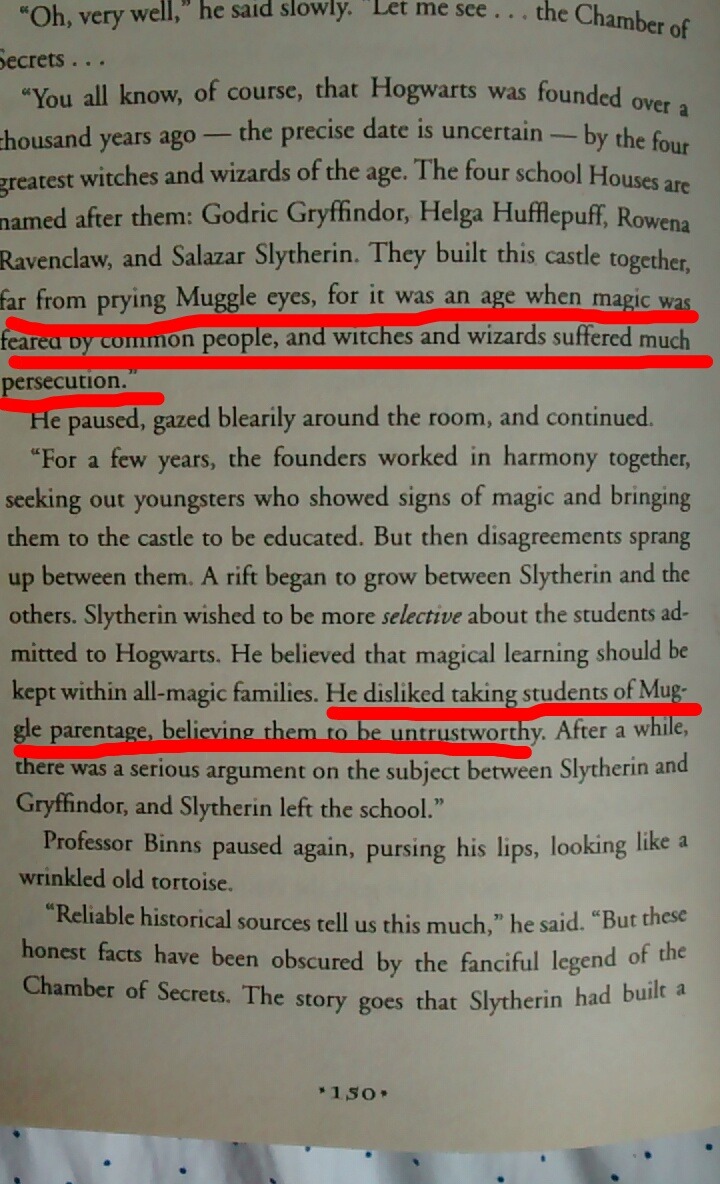
Here it is, canon evidence that Salazar Slytherin was NOT a racist bigot. He was concerned for the well-being and safety of the magical community, which could have been compromised by letting the “common people” know that wizards and witches existed.
Shoutout to this fine lady for bringing this to my attention. Let’s further the argument:
Hogwarts was canonically founded around 990 A.D. – The Christians were finally taking hold of Scandinavia, meaning that all of Europe was now Christian. It was towards the end of the Dark Ages, or else the Early Medieval Period, which (In Europe) was famous for its intolerance of non-Christiandom, which included the teachings of Ancient Rome, Greece, and of course any Eastern countries. People were publicly defamed and in many cases killed for as much as considering these old ideas and teachings. These teachings really didn’t come back to light until the Italian Renaissance in the 14th century.
So when people did things the Christians couldn’t explain, they blamed it on Witches; people they believed to be inhabited by the devil, sent to earth to wreak havoc on every God-fearing man, woman, and child. So what did they do? Imprison or kill those people.
Now, here comes Gryffindor, Hufflepuff, Ravenclaw, and Slytherin, who all agree to take pureblooded witches and wizards and teach them. But then they have to discuss magical folk who aren’t born from magic folk.
Gryffindor is brave and brash, and imagines the glory of having an entire society of witches and wizards with great command of their powers.
Hufflepuff is kind and loving, and wants to provide a sanctuary for all those who are under duress from the population at large.
Ravenclaw sees the merit in bringing all these different people together – the amount of information regarding magic that can be shared is the stuff of her dreams.
Slytherin is cautious. He recognizes that there is a great possibility for individuals to play spy for the Muggle community, in hopes to gain favor by outing them all the while hiding their own powers from muggles. He sees them as a potential threat, and instead of risking the safety of not only their own lives,but the countless volumes and tomes of ancient wizarding knowledge tucked away in their castle (see The Burning of the Great Library at Alexandria), Slytherin says “I really don’t think we should allow people with connections to Muggles in here. We could lost *everything.*
Gryffindor calls Slytherin a coward, saying they would fight back and beat down any who try to oppose them. Slytherin suggests they do all they can to avoid confrontation. Hufflepuff can’t bring herself to deny that sanctuary she’s built. Ravenclaw sees endless potential in bridging that gap between worlds with learning. And this is what drives them apart. Future racists and pureblooded elitists will take and twist Slytherin’s words, having heard only the story that has been passed down for a thousand years. They use words of caution to justify their want for genocide.
Slytherin isn’t the bad guy, here. And I am so down for clearing his name.
To continue the crusade to clear the name of Salazar Slytherin, I have more evidence for your consideration. This is regarding the Chamber of Secrets.
Now, the scene pictured above is one of Harry’s slightly less dull History of Magic classes, in which Professor Binns is asked to talk about the Chamber of Secrets. What we get from him is that the Chamber is a myth. There is legend surrounding it, no one is sure if it exists, etc etc etc.
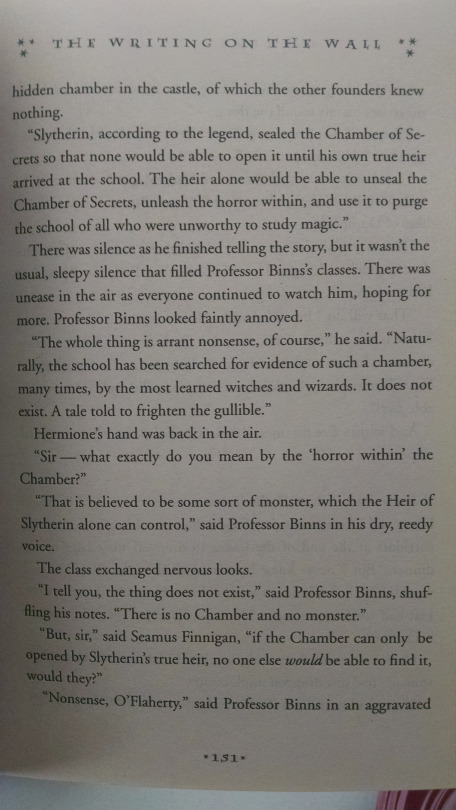
Here is the VERY NEXT PAGE in the book, in which Professor Binns again admits to the Chamber (as we know it today) to be a complete myth. We find out, obviously, that the chamber isn’t a myth, but I believe that the purpose of the chamber has been fabricated over a thousand years by misinformation and slander.
Let’s check it out. Rowena Ravenclaw, Helga Hufflepuff, and Godric Gryffindor all know Salazar Slytherin and say “yep, he’s an upstanding man. Let’s start this school with him!” For a number of years, they had a school together and it worked out great. What we know is that there was a falling out, not Slytherin declaring they needed to murder muggle-borns! A disagreement that may have ruined friendships but did little else, I think.
What we know is that one of Slytherin house’s key virtues is self-preservation. As I discussed earlier in the thread on this post is that Slytherin was afraid of muggle-born witches and wizards acting as spies for the larger muggle community during a time in which wizards and witches were killed for their “demon powers.”
And so, when it comes to the Chamber of Secrets, I believe Slytherin built a Panic Room, not an Evil Lair.
Think about it. Slytherin is horrified that any day there might be an attack on the school. So he builds a secret chamber that only he (or another parseltongue, an incredibly rare magical ability) can open. He doesn’t want any double agents or spies to know about it, so he tells no one. He hopes, of course, that he never has to use it, but in the event that there is an attack, he can get the school to safety while he sets the basilisk on the attackers.
But I’m sure you’re looking at the basilisk and thinking “what sane man would put a monster in a panic room?” Glad you asked. I can consider two possibilities.
1) Slytherin put a basilisk that was under his control in the chamber, a creature that he could set loose on his enemies, aka, anyone attacking the castle. The basilisk would annihilate any army of thousands just by looking at them, and what’s more, it could get almost anywhere in the castle through the goddamn walls! That kind of power is exactly what you need to defend your castle. And again, ONLY HE or an heir could control it. I’m sure at this point he was thinking about himself and his potential progeny, not Tom Riddle some thousand years later.
2) Slytherin didn’t put the basilisk there, and it was instead placed there later by Tom Riddle while he was at school. I don’t have evidence supporting or disproving this.
So how does this get so misconstrued to modern-day Hogwarts lore? Maybe toward the end, the founders did find out about the Chamber. Maybe Slytherin said something to them, maybe he let it slip…maybe as they were cleaning out his room after he left, they found some journal entries about it. It could have been anything. But perhaps, in their wisdom, seeing no way to access the chamber, felt it best that no one knew about the existence of a (now) useless panic room, nor did they want anyone to worry about the basilisk.
Maybe word *did* get out, though. And not one of the founders wanted to admit that Slytherin didn’t trust their students, and so to most of the student body, Slytherin’s departure was suspect. And the moment they heard about a secret room that no one was quite sure about, they started inventing campfire stories about it.
Fast forward ONE THOUSAND YEARS and now everyone assumes Slytherin was always evil (despite being a good friend and founder of Hogwarts with three other lovely people) and created a secret evil lair to murder muggle-borns, which he could have easily done without a lair if that was *ever* his intention.
Thank you so much! I’ve been looking for this post. I always felt like Slytherin being a horrible evil bigot never really made any sense historically speaking, and it just doesn’t add up. Although I have to say I don’t put much stock in option 2. The dude could talk to snakes. And as Hagrid will happily tell you, a creature being scary and “monstrous” doesn’t make it evil. Why couldn’t he be a Hagrid, with a fondness for big “misunderstood” creepy crawlies? Having a basilisk doesn’t make Slytherin evil in and of itself, any more than Hagrid having an acromantula makes him evil, even if most of wizarding society would condemn him for it. Obviously popular opinion isn’t always accurate.
The conservationist and history nerd in me feels a pang whenever I think about how much of a loss that basilisk was. I know it was being used for murder and that it needed to be stopped, but it’s a knee-jerk reaction to such a huge loss of knowledge. That thing was alive a thousand years ago. It knew one of the original founders of Hogwarts. Any parselmouth could have spoken to it and asked it what things were really like in those days and gotten a first hand account, but unfortunately the only person to speak to it in a millennium was an idiot who only thought about killing people. Did he even think to ask its name? Nagini clearly had a name, but he never refers to the basilisk by name. That’s just… really sad to me.
I think a lot of people forget that Slytherin house is more than just self-preservation too; loyalty is a core value. Slytherin’s message is about protecting your own more than nearly anything else. Slytherin pushes unquestioning acceptance of and loyalty to your fellows, regardless of blood status, even in Harry’s day, according to their welcome message on Pottermore. You very rarely see a Slytherin making a disparaging remark about another Slytherin. You do see even the most bigoted Slytherins (like the Malfoys) being supportive of Slytherins who are much lower on their little social hierarchy than them (like Snape). In Salazar Slytherin’s day, I think he would have extended that loyalty to the whole school and the other founders. They were “his own”, and he would have wanted to protect them.
In depth analysis about Harry Potter is what i’m here for
this is the theory i’ve been looking for
“Those who are unworthy to study magic” doesn’t equal “muggleborn.” Slytherin was worried about letting muggleborn students in because of their relationships w/ muggles, who were at the time very dangerous to the wizarding world. These weren’t foolish bumbling Dursleys. These were potentially very violent, very bigoted threats.
Imagine that Slytherin was afraid of a scenario where Hogwarts was betrayed by some (not all) muggleborns—or by their muggle relatives. Say you’re a 10th century muggle & you find out your child is a witch–how supportive are you likely to be? Keep in mind we’ve already seen how quick, even now, 1,000 years later, too many families are to betray and even kill their own kids for not being ‘normal’ (think of lgbtqa+ youth, for instance). And in this scenario, these muggles were a danger not only to their muggleborn kids, but to the entire Hogwarts community. What was to stop a bigoted relative of a muggleborn from gathering up an angry mob and invading the castle, beauty and the beast style?
Well, we know Hogwarts has certain protections from muggles. Muggles can’t see or access the castle, for example, at least in modern day. So theoretically, muggles would need magical assistance to invade Hogwarts. And since the only magical beings they knew in the first place were muggleborns….
Imagine that Slytherin was motivated not by bigotry but by serious concern for the school’s safety in the case of being betrayed by a muggleborn student. Now ‘betrayal’ could mean a muggleborn being pressured or outright forced by muggles to help with an invasion. We’ve seen plenty of times in the books characters being forced to choose between loyalty and fear, between friends and family, between what they know is right and what they are pressured to believe. To put it in a familiar way: to choose between what is right, and what is easy. And we saw characters makes the wrong choices, and the great costs that followed.
So what if “those who are unworthyto study magic” never meant muggleborns? What if it meant those who would betray Hogwarts (muggle, muggleborn, or otherwise), or (more relevantly) those who would fail to protect it when protecting it came at the cost of their lives, or the lives of their families. An unfair, impossible situation to be in. But a situation that 10th century muggleborn students were very likely to be put in, far more likely than their magicborn peers.
For Slytherin, the best solution was the safest one: don’t risk letting them get into that position in the first place. Don’t risk making muggleborns choose between the magical and non-magical world. By not giving them the choice in the first place. Let them stay in the non-magic world, where they could be safe, and where they could not endanger others. This would come at great cost—to the muggleborns who would never receive their Hogwarts letter, would never receive their birthright, and to the magical world who would never receive the gifts and talents and wonders all the muggleborns had to offer.
A great cost, to avoid a potentially greater one, at a time when the collision of the magical and non-magical worlds often ended in fire and violence. A time when simply being a Hogwarts student came at the risk of being burned alive in case of discovery. How terrifying for a school founder to know that just by attending school their students were being put in danger of death. What a terrible responsibility to have to balance.
i just realized something: think about padme amidala’s public image. nobody knew she was married. nobody knew who anakin skywalker was at all–he was just some random jedi trainee, and by the time anybody would have started paying attention to him in the public eye, they would have known him as darth vader. to the public, anakin became a faceless villain who always was who he was, no fall from grace needed.
so, padme. i’m sure she had supporters across the republic. i’m sure her time as queen of naboo was EXTREMELY well-documented, and honestly, based on her rotation of outfits, she was probably a full-on celebrity. she was young and brilliant and a passionate defender of her people, and even though the empire seized power in the end, i wouldn’t be surprised if the rebellion decades later directly descended from the ideals of her followers.
but think about the circumstances of her death from the outside. people probably knew she was pregnant by some unknown father, of course, but this is a universe with robot doctors–saying “she died in childbirth” would probably be like saying “she died of the common cold” today. not something that happens, especially for a celebrity politician with unlimited resources. and there must have been a child, but what happened to it? did it die too? as a media narrative, it’s flimsy at best, ESPECIALLY considering the timing of her death.
padme amidala, the woman who ruled a planet at 14 and sat stony-faced while every other senator cheered on palpatine’s rise to power, died under mysterious circumstances just as the government she’d defended crumbled. from the outside, it seems pretty obvious that she was assassinated.
if this was a universe that at all made sense, padme amidala would have been a household name among republic loyalists. her tragically short life, her noble self-sacrifice for the ideals she believed in, would have been LEGENDARY. when the rebellion rose, she would have been the name on everybody’s mind–do it in her honor, people would have said. finish the fight she started.
i know we can’t go back in time and change the original trilogy, but the sequel movies? come on. don’t tell me darth vader is the only looming icon in this franchise.
To make it extra tragic – in the EU it mentions that the coroner used some kind of hologram technology to make it look like she was still pregnant at the time of her death, to protect the twins from the emperor and Anakin by telling everyone that the children had never been born. Padme Amidala’s death would have been the tragedy of the century, the face of the lost democracy.
Okay but what if that celebrity factor got used? By, like, everybody.
To the Naboo people, she’s their beloved Queen. To much of the galaxy, she’s a loved and admired public figure and stateswoman. To the Republic loyalists, she’s their martyred supporter, the vanquished—murdered, they think—face of Democracy. To the Empire, she’s a useful idol, the Emperor’s colleague, murdered, they say, by Separatist forces or by Jedi, tragically dead and conveniently silent, beautiful and glamorous and perfect for starting a cult of personality on her behalf.
And here and there, among the various cultures, there are religious concepts like sainthood, ancestor worship, legends of dead protectors coming to life again to fight when they’re needed. And conspiracy theories, and wishful thinking turned speculation, and the Star Wars equivalent of tabloid newspapers.
The result? Padmé is the most popular and famous woman in the galaxy, a combination of Princess Diana, Mother Teresa, Che Guevara, Joan of Arc, Elvis Presley, Arthur Pendragon, Chuck Norris, and the Virgin Mary.
One of the most important Imperial holidays is Amidala Day, devoted to celebrating service to the Empire, the official story of the Empire’s birth, the Emperor’s home world, and the heroic Queen and Senator whom Palpatine claims as his staunch supporter. People paint their faces and make elaborate hairstyles or headdresses and put on their fanciest clothes; there are plays, and parties, and traditional Naboo dances and foods.
Vader hates it. This is about 60% of why the Emperor has made such a production of it.
Among Republic loyalists, a different story is told: a Queen Amidala who loved peace and democracy, who opposed war and worked tirelessly for ceasefires and peace treaties, who stood silently or wept as all around her cheered the newborn Empire; a Queen Amidala who was murdered by the Empire so he could create the fiction of her support.
Vader hates this too. It feels uncomfortably true, and threatens to undermine his resolve that she would have been at his side had she lived.
Rebels paint images of her on their fighters, hang holos of her on their walls, wear icons of her as good-luck talismans. There are exhortations, penned semi-anonymously by people who knew her, that she would have wanted people to join and support the Rebellion. The minimalist image of eyes, cheek dots, and paint-split lips are graffiti’d onto public monuments accompanied by words from her speeches. “Amidala Needs You” is a common phrase on Rebel recruitment posters.
Vader hates this most of all.
Statues and icons of her are made in a hundred different artistic styles and adorn the altars of a thousand worlds’ faiths. Mythologies are written about her: she stopped a Separatist advance with words once, appeared in a dream to a slave telling her where her transmitter was hidden, shot five destroyer droids with pinpoint accuracy before they got their shields up, stormed her own palace to take it back from the Trade Federation, cheated death at the hands of the Empire’s assassin, escaped with the help of the last of the Jedi, is still out there somewhere, mourning for the Republic on some uninhabited planet somewhere, training in secret lost Jedi arts to kill the Emperor, working as a Rebel agent or a disguised vigilante.
Vader dislikes this. But he also seeks them out and reads them, when he’s in a certain mood.
The tabloids regularly claim that she’s been seen working as a roast-traladon restaurant in some backwater suburb of Corellia, or navigating a spice freighter to and from Kessel, or singing at a nightclub on Nar Shadda.
Vader dislikes this too. He has to talk himself out of keeping an agent or three just to visit the places in question and make sure.
He isn’t often in a position to see teenage girls with Padmé’s face emblazoned across their tunics, or walls with familiar face paint next to “So this is how liberty dies: to thunderous applause” printed next to it. When he hunts down Rebels with her image on a chain around their necks for luck, he can tear them apart with the Force: a quick death, which is, ironically, the luckiest outcome available to them. Tabloids and legends can be read and dismissed, and he’s never had the opportunity to happen upon the fanfiction.
But when the Emperor commands, Vader stands at his side through parades and parties and celebratory addresses to the Senate, with Padme’s image on banners and holos, with Padmé’s image on stage saying words Padmé never said, with all the women and half the men wearing Naboo royal face paint, and accepts the pain of memory almost like a form of self-harm.
And when the newly-elected Junior Senator from Alderaan with a quiet grace that reminds him of her and a fire in her eyes that reminds him of himself asks him, at some interminable party, if he knew what she was like, he troubles himself to answer honestly.
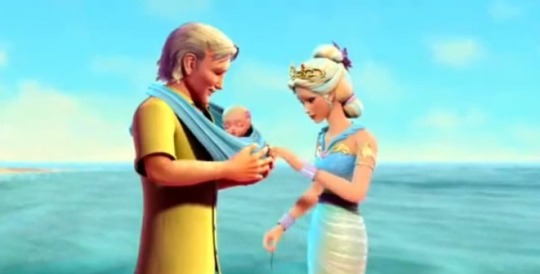
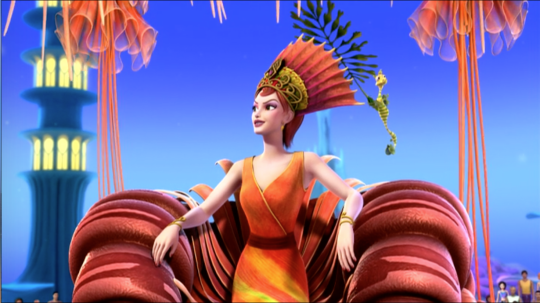
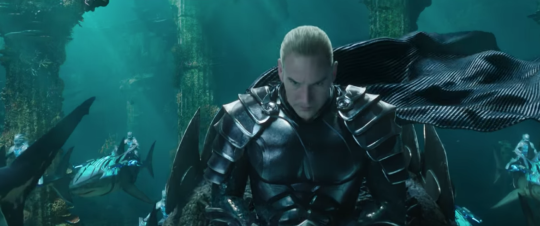
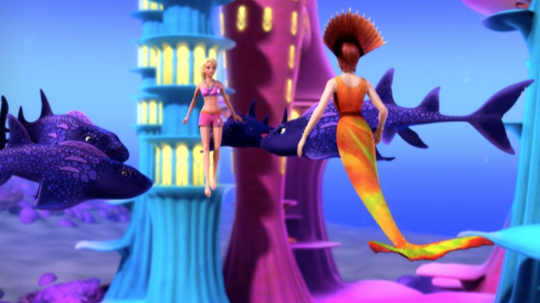
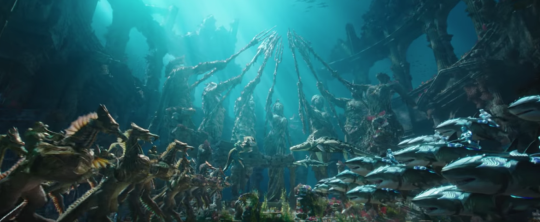
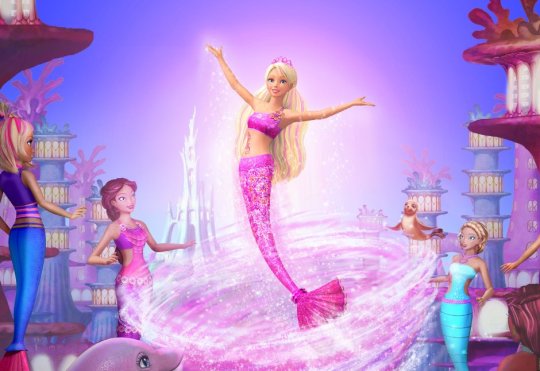
It has come to my attention that Aquaman (2018) is just a shameless ripoff of the Mattel classic, Barbie: A Mermaid Tale.
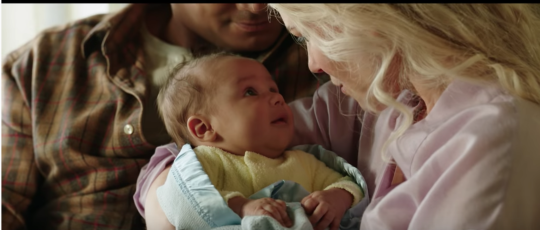
We have the child of a mermaid queen and a regular human guy
who was brought up in the human world as a free spirit,
who talks to sea creatures,
who is fated to take over the throne of an underwater kingdom (where all the buildings are round and mushroom-y)
which is currently being occupied by an evil, power-hungry relative
with an army of sharks
And their unique position, straddling the human world and the underwater world, is at first a burden but ends up being their greatest strength
… I’m just saying
So what you’re saying is, basically, Aquaman is a Barbie Princess. Fair enough.
I’m more interested in the fact that Barbie made an Aquaman story (Aquaman came first sorry) but didn’t call it “Barbie as Aquaman” because i watched all the “Barbie as” movies when I was younger and this would have been amazing

























 myblog