so here’s a quick lesson about having patience with kids.
I have a 6th grade student who isn’t really interested in doing her homework (big surprise). from my experience, kids who aren’t trying to do their homework usually fall into two general categories – “this is too easy and therefore boring” and “this is too hard and therefore i’m not even going to attempt”. it became clear by October that she fell into the latter group, but most of the staff chalked it up to “she doesn’t understand it”. I didn’t really believe it because she was a very smart, emotionally aware girl and it didn’t seem like she didn’t always want to try, just that she would rather do other things than struggle with her work.
yesterday, she got sent to my office, just so that she would have a space away from her friends to focus on her work, and she asked me to help her with two questions. I looked at them and they were fairly straightforward, simple questions about the results of using various amounts of force on an object. I did what I always do – I read the question out loud first, and then tried to help her use recall to figure it out. she did in a snap. I did the same with the second question, and before I even finished it, she went “OH!” and started writing her answer.
that’s when it hit me – she doesn’t have trouble with the material, she just has trouble reading and processing what she’s reading at the same time. big difference! I asked her and she confirmed that it was easier to hear a question and understand it than to read it and understand it. so I got her phone out, pulled up her voice recorder, and told her to try reading the question aloud and then playing it back to herself so she could process it and she looked like i had handed her the holy grail.
the moral of the story is that sometimes you have to set aside what you think is a problem with a kid and just watch for what’s easier for them. will she be able to do that during a test? maybe not, BUT now that she knows that the issue is processing reading and that she’s an auditory learner, she’s in a better position to ask for resources to help her work better in school.
so i’m off to the school counselor to let her know so she can possible get more tools for auditory learners.
People like this are amazing, seriously. I really admire their patience and their will of wanting understand kids, in this case, and trying to solve the problems. Great lesson here
A cat can jump up to five times its own height in a single bound.
The little tufts of hair in a cat’s ear that help keep out dirt direct sounds into the ear, and insulate the ears are called “ear furnishings.”
The ability of a cat to find its way home is called “psi-traveling.” Experts think cats either use the angle of the sunlight to find their way or that cats have magnetized cells in their brains that act as compasses.
One reason that kittens sleep so much is because a growth hormone is released only during sleep.
A cat has 230 bones in its body. A human has 206. A cat has no collarbone, so it can fit through any opening the size of its head.
A cat’s nose pad is ridged with a unique pattern, just like the fingerprint of a human.
If they have ample water, cats can tolerate temperatures up to 133 °F.
A cat’s heart beats nearly twice as fast as a human heart, at 110 to 140 beats a minute.
Cats don’t have sweat glands over their bodies like humans do. Instead, they sweat only through their paws.
The claws on the cat’s back paws aren’t as sharp as the claws on the front paws because the claws in the back don’t retract and, consequently, become worn.
Cats make about 100 different sounds. Dogs make only about 10.
Researchers are unsure exactly how a cat purrs. Most veterinarians believe that a cat purrs by vibrating vocal folds deep in the throat. To do this, a muscle in the larynx opens and closes the air passage about 25 times per second.
A cat almost never meows at another cat, mostly just humans. Cats typically will spit, purr, and hiss at other cats.
A cat’s back is extremely flexible because it has up to 53 loosely fitting vertebrae. Humans only have 34.
Some cats have survived falls of over 65 feet (20 meters), due largely to their “righting reflex.” The eyes and balance organs in the inner ear tell it where it is in space so the cat can land on its feet. Even cats without a tail have this ability.
A cat can travel at a top speed of approximately 31 mph (49 km) over a short distance.
A cat’s hearing is better than a dog’s. And a cat can hear high-frequency sounds up to two octaves higher than a human.
A cat’s brain is biologically more similar to a human brain than it is to a dog’s. Both humans and cats have identical regions in their brains that are responsible for emotions.
And that’s how cats work.
I learned more about cats in this post than I did in my freshamn biology class in college
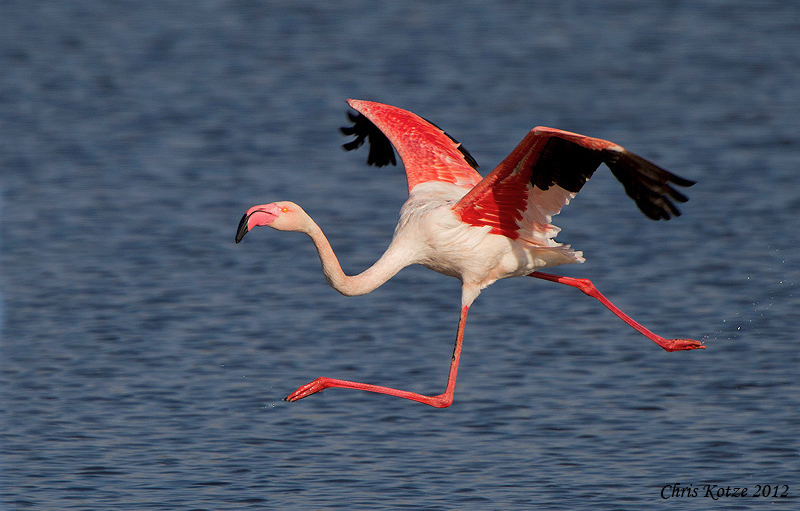
So I’m watching a Sir David Attenborough (Natural Curiousities on Netflix), to cope withe the crushing lonliness of solo housesitting, and he’s on about Really Weird animals and talks about the origins of the pheonix- a bird that people travelling though Africa only rarely saw shrouded in the streamy mists of volcanic soda lakes (which are literally boiling hot and also extremely caustic).
And all they’d see is the occasional bit of bright red plumage and see these things bobbing in and out of the horrible death clouds coming off the lake, and naturally came up with the myth of a firebird what the fuck ELSE would be living IN A GODDAMN VOLCANO??
The Central Africans told this to the Egyptians who told the Greeks* about this mysterious animal, and they ran hog-wild with it to create the now-famous Pheonix, but-
The bird they were seeing in those volcanic lakes?
*There is significant academic debate about who told who what when (esp as the firebird myth has cropped up multiple times and been culturally exchanged many, MANY times) but the Flamingo>Egyptian Bennu>Greek Pheonix>European Pheonix chain is fairly well agreed upon.
Some of my favorite tags so far:
@asleepinawell “Natural Curiousities” is on netflix and I think the PBS streaming app. BBC streaming keeps crashing on me but probably there too. It’s very much like his usual work, but with 500% more “Look at these funky specimens and the frantic scribbles of early scientific illustrators confronted with a fucking kangaroo” and “I’m Sir David Fucking Attenborough And I’m Going To Snuggle This Cheetah”
@heedra You are correct! According to Wikipedia: “The name “flamingo” comes from Portuguese or Spanish flamengo, “flame-colored”, in turn coming from Provençal flamenc from flama “flame” and Germanic-like suffix -ing, with a possible influence of words like “Fleming” THEY WERE TRYING TO TELL US ALL ALONG!
@melifair You’re in good company- I used to call them “Pimentos” until I was three and finally got the hang of the Letter “F”
Also, Apologies about the spelling. I have a reading disorder and it causes me to mis-read and by turn misspell certain words, especially ones with two nonidentical vowels in the middle of the word like Their and Becuase. Good thing we all know what I’m talking about anyway!
But how could you not tell us WHAT THE FLAMINGOS ARE DOING IN A VOLCANO?????
So Flamingoes are pretty badass.
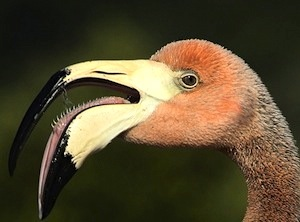
They’re hyperspecialized filter-feeders, not unlike krill-feeding whales, and thier heads are shaped Like That, so they can dangle thier heads in the water, suck up water full of algae and brine shrimp and other goodies, and filter them out with thier Spiny Tongues.
(Image Source Apparently, according to the Ancient Romans, Flamingo Tounge has a “Superb” flavor. You Wacky Roman Bastards)
But the lakes with the tastiest and most dense algae and arthropods are not Normal lakes. African Lesser Flamingoes (lesser becuase they have a smaller range, but probably our phoenix given how people were travelling at the time) like to hang out in extremely Alkaline Lakes where thier favorite algae grow, and those lakes are mostly in the volcanic Great Rift Valley. Where the lava and occasional venting of hot toxic gasses happen.
In addition to the wierd diet, and caustic water, Flamingoes can also cope with some pretty intense climate. The Alkaline Lakes Lesser Flamigoes like are also VERY HIGH in the mountains, where they cope with low oxygen, Intense UV radiation, and rapid and extreme temperature fluctuations- below freezing at night and heatstroke hot in the day.
You can tell how well a Flamigo is Flamingoing by it’s color! The lovely red-pink color comes from the algae and arthopods they eat: the better-fed and healthier a flamingo is, the more intense thier colors will be! Zoo famingoes can thrive on a wide variety of diets, but thier colors will fade, and it will cause everyone to lose romantic interest, so they have to be fed a special color-intensive diet to keep breeding programs going.
So while Flamingoes probably weren’t the bird you were picturing when you thought of a Phoenix , they’re Pretty Badass and worthy of the mythic lore.
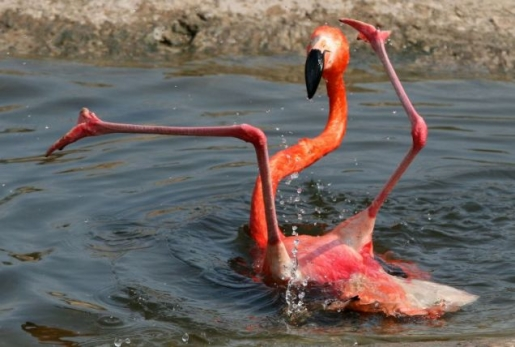
Oh yeah that’s another thing they do, the doofy little badasses.
BTW, It’s not that Flamingoes are born with normal propprtions and get Like That later- they’re born as bizzare as the adults, but smol, so until they get large enough to actually stand above the 6-12 inches of water that’s usually around the nests, they run the risk of drowning or alkaline burns that become infected. Fortunately, Flamingo parents are extremely attentive and do a good Job of making sure their babies stay safe and dry until they’re leggy enough to wander around with the flock.
All this really is a way to show pictures of baby flamingoes.
“I want to be a hematologist. That’s a blood doctor. Well not a blood doctor, exactly. But a doctor that finds cures for blood diseases.” “How’d you decide on that?” “We were dissecting frogs in class and learning about how the blood flows through the body. And I went home that night and wrote an essay. And it wasn’t like any other essay I’d ever done. Normally when I write essays, it takes me a long time, but this was the fastest essay I ever wrote. So the next day I was asking the teacher mad questions, and she was like, ‘You know you can get a job in this.’ And she pulled it up on the internet, and was showing me all about hematologists.”
SUPPORT THIS BOY
I love it when someone gets that thunderbolt “I wanna do this forever” moment. It’s amazing to see that change in them once they’ve got an actual concrete dream to work towards.















































 myblog