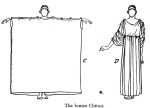
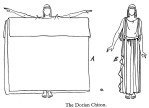
Wait, wait…. Is that seriously it? How their clothes go?
that genuinely is it
yeah hey whats up bout to put some fucking giant sheets on my body
lets bring back sheetwares
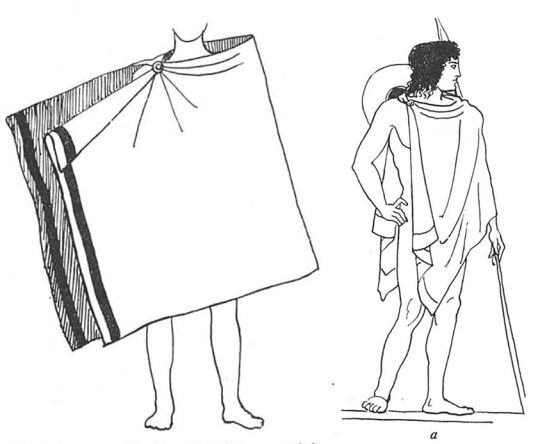
also chlamys:
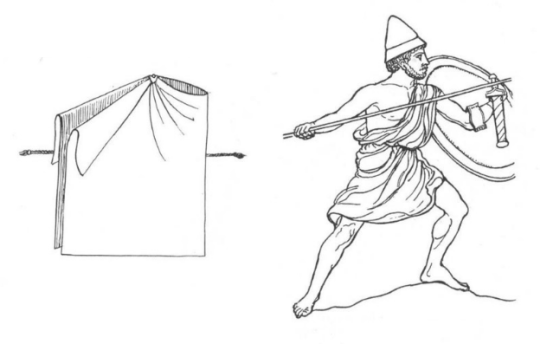
and exomis:
trust the ancients to make a fashion statement out of straight cloth and nothing but pins
Wrap Yourself In Blankets, Call It a Day
Ok, yes, but guys, look
Prior to the Industrial Revolution, fabric was EXTREMELY time consuming to make, and as such, was extremely valuable. You have to grow your fiber, either in the ground or on an animal. You have to process the fiber. You have to spin the fiber. And spin, and spin, and spin. Spinning technology prior to the late Middle Ages consisted of a drop spindle. It takes forever and a day to spin enough thread to make fabric using a drop spindle – 10-30 times longer than to weave it, depending on how thick your yarn is and what weaving technology you are using. Then, once you are done with that endless task, you need to weave it. The examples in this post are all from Greece, where they used the warp-weighted loom, which is actually a rather efficient piece of weaving technology, but it’s still not as fast as the treadle loom (another late Middle Ages invention) and in no way comparable to a modern industrial loom (essentially the same machine as a treadle loom, but automated (except warping, which is still hell on earth even in 2018)). You know the saying “women’s work is never done”? That saying refers to the fact that unlike, say, field work, or mining, or smithing, spinning and weaving were started before dawn and carried on until after dusk, every day of the year, and there was always, always need for more.
After all of this, every piece of fabric that is made represents literally hundreds of hours of work. It is so valuable it was a standard form of currency before the invention of money. Egyptians piled linen high in their tombs as a show of wealth – and that linen was stolen by the grave robbers along with the gold and other precious artifacts. Textiles were one of the most valuable things you could steal when you pillaged a city. A primary reason for the warfare and raiding that was a consistent part of pre-modern Mediterranean/Near Eastern history was to acquire female slaves to produce textiles. Yes, cooking, cleaning, and sex were also reasons to acquire female slaves, but the economic reason was for textile manufacturing.
So if fabric is that valuable, you’re not going to waste it. You’re not going to make something tightly tailored, because as anyone who sews can tell you, cutting fabric to fit produces a lot of waste. In addition, the cloth of the ancient world was often much more loosely woven than cloth today, which is partly to do with weaving technology but most to do with the fact that the denser the cloth, the more threads there are in it, which means the more threads you have to spin for it, which means the time you have to spend making it has just gone up dramatically. Loosely woven cloth ravels like hell when you cut it, again as anyone who sews can tell you, and that makes it much more difficult to sew something nicely tailored. Needles and scissors are also items we take for granted, but are, in their modern form, relatively modern inventions and have, historically, been tricky items to make.
Thus, most of the clothing of the ancient Mediterranean/Near East was based on the rectangles of fabric that come directly off the loom. Much of China’s historical dress is similar, at least in the time frames we’re talking about. Throughout European/North African/Middle Eastern history, and in China until silk changed the game (at least for the rich), tailoring skill and technology has lagged behind cloth production skill and technology.
The famous painting from the early Renaissance where the woman is wearing a dress constructed using a truly obscene amount of fabric? That painting is often held up as an example of the sharp increase in the availability of material goods that is the hallmark of the European Renaissance (especially because it is of a merchant family and not nobles), and it is that. But it is also an example of a mode of dress that was difficult-to-impossible to achieve before the invention of the flyer wheel (for spinning) and treadle loom (for weaving), which made cloth take considerably less time to make and therefore considerably cheaper, and which also made cloth considerably more amenable to tailoring.
So yeah. You too would make fashion out of sheets if it took you most of a month of full-time work to produce one sheet.
I also want to point out that much of the historical dress of Sub-Saharan Africa and the Americas (in the places where cloth was used) is similar, it’s just based on narrow rectangles sewn together rather than large rectangles, because these are places where the backstrap loom and/or tubular loom remained the mainstay of weaving technology. Backstrap looms produce narrow lengths of cloth (15-18 inches is usually the limit), so with that weaving technology + some sewing, you get things like Central and South American ponchos and much of the traditional dress of Central and Western Africa.

 myblog